Condenser Fan Replacement in Kuwait | Motor Cost & Time

Condenser Fan and Motor Replacement in Kuwait: Cost & Time
Has your outdoor condenser fan stopped spinning or started running slowly while the compressor keeps shutting down and the cold room temperature rises? Refrigeration condenser fan replacement in Kuwait may be the appropriate solution if the fan motor or blades are confirmed to be damaged. However, not every stationary fan requires replacement. Sometimes the problem involves a faulty run capacitor, an electrical fault, or a normal fan speed control command. Repair costs depend on the motor rating, specifications, brand, component type, and accessibility of the outdoor unit. Service duration is determined after diagnosis and confirmation that a compatible replacement is available. Airflow and refrigeration pressure should also be checked after installation.
Imagine running a restaurant that depends on a cold room to preserve meat and vegetables. You notice an unusual noise coming from the outdoor refrigeration unit, followed by the compressor shutting down and restarting. When you inspect the condenser area, you discover that the fan is not spinning, rotates with difficulty, or vibrates because of a damaged blade. Your first thought may be to replace the fan motor immediately. However, the problem could originate from the electrical supply, contactor, or run capacitor in models that use one. If the motor is replaced without identifying the original fault, the same problem may occur again, particularly if the fan blades are rubbing against the protective guard or the condenser is heavily clogged with dust.
Through Cold Room and Display Refrigerator Maintenance in Kuwait, you can inquire about commercial condensing unit fan inspections, replacement services, and the availability of parts compatible with your equipment model. This guide explains the difference between replacing fan blades and replacing the complete motor, the specifications required when selecting a replacement, and how fan failure can contribute to high refrigeration pressure and compressor shutdowns. It also covers the factors affecting motor prices, installation costs, and expected repair duration after diagnosis, together with the steps involved in testing the fan and condenser before returning the cold room to operation. The objective is to repair the actual fault, protect the refrigeration unit, and avoid replacing functioning components or installing a motor that is incompatible with the equipment.
Refrigeration Condenser Fan Replacement in Kuwait: When Is Replacement Necessary?

Refrigeration condenser fan replacement in Kuwait requires diagnosis to determine whether the fault lies in the fan motor, the blades, or the electrical and control circuits. The condenser fan moves air across an air-cooled condenser to help release heat transferred by the refrigeration cycle. When airflow falls below the required level, condensing pressure may increase, refrigeration efficiency may deteriorate, and a high-pressure switch or another protective device may activate in systems equipped with such protection.
However, a fan being stationary at a particular moment is not sufficient evidence that it has failed. Some commercial condensing units use fan speed regulation or staged fan operation based on condensing temperature and pressure. The technician should therefore confirm whether there is an actual command for the fan to operate, whether the correct electrical supply is reaching it, and whether the condenser and blades are in good condition before deciding to replace the motor.
What Is the Function of a Condenser Fan?
It moves air across condenser fins so the refrigeration system can reject heat.
In some units, the fan may also contribute to airflow around other components, depending on the manufacturer's design.
What Are the Signs That Replacement May Be Necessary?
-
The motor remains stopped despite receiving the correct operating command and electrical supply.
-
The motor becomes unusually hot.
-
Grinding, rubbing, or humming noises are traced to a confirmed fault.
-
Motor bearings are damaged.
-
Persistent vibration results from a defective fan assembly.
-
Electrical winding damage is confirmed through testing.
-
A fan blade is damaged or becomes detached from its mounting.
-
Repeated shutdowns are traced to a confirmed motor fault.
Is Replacing the Fan Blade the Same as Replacing the Motor?
No. The fan blade is the component that moves air, while the motor provides the rotational movement.
The blade alone may need replacement if damaged, the motor alone may need replacement if defective, or the complete assembly may need replacing depending on the equipment design.
Can the Motor Be Functional Even When the Fan Does Not Spin?
Yes. The problem may be caused by the electrical supply, control circuit, or run capacitor in equipment that uses one.
Mechanical interference may also prevent the blade from rotating even when certain electrical components remain functional.
Do All Condenser Fans Run Continuously?
No. Some condensing units control fan operation according to condensing pressure or temperature.
The technician must therefore establish whether the stationary fan is operating contrary to the manufacturer's intended control sequence.
Is It Dangerous for the Compressor to Run Without the Condenser Fan?
The loss of required airflow may cause condensing pressure or operating temperature to increase and trigger protective devices.
The system should not be forced to continue running when a genuine condenser cooling fan fault has been identified.
Should the Fan Be Replaced Immediately After a High-Pressure Alarm?
No. High pressure may also be caused by a dirty condenser, inadequate ventilation, or other refrigeration circuit problems.
The fan must be confirmed as the cause before it is replaced.
Determining Whether a Condenser Fan Needs Replacement
|
Condition |
Possible Explanation |
Appropriate Decision |
|
Motor stopped despite correct power supply |
Motor fault |
Evaluate replacement |
|
Motor functional but no power reaches it |
Electrical or controller problem |
Repair the missing supply or command |
|
Broken fan blade |
Mechanical damage |
Install compatible replacement blade |
|
Severe vibration |
Blade, mounting, or bearing problem |
Inspect fan assembly |
|
Fan spinning slowly |
Speed control or fault |
Check model and operating measurements |
|
Condenser covered in dust |
Restricted airflow |
Appropriate cleaning |
|
Fan stopped during staged control |
Potentially normal operation |
Review controller commands |
|
High pressure while fan operates |
Other possible causes |
Inspect condenser and refrigeration circuit |
The key consideration: Condenser fan replacement is appropriate when motor or blade damage is confirmed. If the fan stops because of an electrical or control problem, the underlying cause should be repaired instead of purchasing a new motor immediately.
Commercial Condenser Fan Motor Prices: What Determines the Cost of the Part?
The price of a commercial condenser fan motor is not the same for every refrigeration unit. Motors differ in electrical power, voltage, rotational speed, control method, protective specifications, and operating temperature limits. A fan motor installed in a small condensing unit may be very different from a motor used in a multi-fan condenser serving a large cold room or freezer facility.
Prices may also vary depending on whether the required motor is an original component for a particular model, an approved compatible replacement, or a complete assembly containing the motor, blade, and protective components. Even two motors with the same wattage cannot automatically be considered interchangeable. Rotational speed, direction, blade mounting, and required airflow influence performance.
What Is Included in the Fan Motor Price?
-
Motor brand and model.
-
Electrical power rating.
-
Operating voltage.
-
Electrical supply type.
-
Rotational speed.
-
Required direction of rotation.
-
Speed control specifications.
-
Shaft diameter and mounting arrangement.
-
Protection against dust and moisture.
-
Bearing type.
-
Permitted operating temperature conditions.
-
Availability of a compatible replacement.
-
Whether the motor is sold alone or with the fan blade.
-
Removal, installation, and testing labor.
Is a Higher-Wattage Motor Better?
Not necessarily. Installing a motor with a higher power rating does not guarantee the same required airflow or better performance.
The motor must remain compatible with the unit's design, fan blade, and electrical circuit.
Can Any Motor with the Same Voltage Be Installed?
No. Voltage alone is insufficient because motors may differ in rotational speed, control arrangement, mounting requirements, and power ratings.
The complete specifications of the original motor must be reviewed.
Is an Original Manufacturer Motor Necessary?
The preferred option is the component specified by the manufacturer or an approved replacement that meets the required technical specifications.
A motor with unknown specifications should not be installed simply because it fits the available mounting space.
Does the Price Include the Fan Blade?
This depends on the supplier's quotation and how the components are sold.
The motor and blade may be supplied separately, or they may be available as one complete assembly.
Is the Price Different for a Freezer Room Condenser Fan Motor?
It may differ according to condensing unit size and operating specifications. However, the freezer room temperature alone does not determine the motor's price.
The specifications of the condensing unit and required fan are more important.
Can the Price Be Determined from a Motor Photograph?
A photograph may help identify the component and its label, but it may be insufficient when the technical information is unclear.
It is better to provide photographs of the motor nameplate, the condensing unit model number, and the fan blade diameter.
What Is the Difference Between the Part Price and Service Cost?
The component price covers the motor or fan assembly. The replacement service may include diagnosis, removal, installation, electrical connections, and testing, depending on the agreement.
Additional arrangements may be needed if the outdoor unit is difficult to access.
Factors Affecting Commercial Condenser Fan Motor Prices
|
Pricing Component |
What Must Be Identified? |
|
Brand |
Manufacturer and model |
|
Power rating |
According to motor nameplate |
|
Voltage |
Compatible with unit supply |
|
Motor type |
According to equipment design |
|
Speed |
Matches required specifications |
|
Fan blade |
Diameter, design, and direction |
|
Mounting |
Shaft and support brackets |
|
Control |
Direct or variable-speed operation |
|
Protection |
Suitable for installation environment |
|
Spare parts |
Original or approved compatible replacement |
|
Installation |
Removal and electrical connection work |
|
Testing |
Airflow and operating performance verification |
Commercial condenser fan motor prices depend on specifications and compatibility, not simply the apparent size of the motor in a photograph. Installing an unsuitable component may create additional repair expenses after replacement.
Cold Room Condensing Unit Fan Replacement: Repair Steps from Diagnosis to Testing

Cold room condensing unit fan replacement requires a clear technical procedure so that the fault is corrected without affecting other parts of the equipment. The technician first identifies the fan type and the number of fans installed in the condenser. They then determine whether the motor is operated by direct commands or through a fan speed control system. After that, the electrical supply, blade condition, mounting, and condenser cleanliness are inspected before identifying the component requiring replacement.
Importantly, the fan must not be removed while electrical power is present or before every moving component has stopped. Certain equipment has multiple electrical supplies or control modules that may restart fans automatically. A run capacitor, when installed, may also retain an electrical charge after power is disconnected. Removal, wiring, and testing must therefore be performed by a qualified technician following proper energy isolation and verification procedures.
What Is the First Step Before Replacing the Fan?
The technician records the unit and original fan specifications, describes the symptoms, and determines whether the fault involves the motor, blades, or electrical supply.
This helps ensure that a compatible component is selected rather than purchasing an unsuitable motor.
Does the Cold Room Need to Be Shut Down During Repairs?
The condensing unit may need to be stopped and its electrical supply safely isolated, depending on the system design.
Stored products must be protected, and their temperatures monitored during downtime.
Does Removing the Fan Require Opening the Refrigerant Circuit?
In many designs, the fan assembly can be replaced without opening the refrigerant circuit.
However, this depends on accessibility and equipment construction. Not every condensing unit has the same design.
Must the Electrical Wires Be Replaced Along with the Motor?
Not always. However, wires, insulation, and connections should be inspected, and damaged components replaced according to the equipment specifications.
Connections unsuitable for the installation location or operating conditions must not be used.
Can the Old Fan Blade Be Installed on a New Motor?
Only if it is undamaged and compatible with the shaft diameter, mounting arrangement, required rotational speed, and direction.
A similar appearance alone does not establish compatibility.
Is It Necessary to Check the Fan's Rotation Direction?
Yes. Rotation direction and blade configuration determine how air moves through the condenser.
There is no single rotation direction suitable for every unit; manufacturer instructions must be followed.
What Should Be Tested After Replacement?
-
Stability of motor mounting.
-
Condition of the fan blade.
-
Absence of mechanical rubbing.
-
Airflow direction.
-
Vibration and operating noise.
-
Voltage and current according to specifications.
-
Controller response.
-
Operation of other installed fans.
-
Condensing pressure when appropriate.
-
Compressor operating stability.
-
Improvement in refrigeration performance.
Cold Room Condenser Fan Replacement Procedure
|
Stage |
Required Work |
Objective |
|
Diagnosis |
Identify the fault source |
Avoid replacing a functional part |
|
Model verification |
Read motor specifications |
Select compatible replacement |
|
Equipment isolation |
Secure energy sources and work area |
Protect technicians and equipment |
|
Removal |
Remove the defective component |
Access the assembly |
|
Blade inspection |
Check damage and mounting |
Prevent vibration |
|
Installation |
Secure the appropriate replacement |
Restore operation |
|
Electrical connection |
Follow approved wiring requirements |
Electrical safety |
|
Rotation test |
Check airflow direction |
Proper condenser performance |
|
Operating measurements |
Monitor current and pressure |
Verify compatibility |
|
Handover |
Document completed work |
Support future maintenance |
Replacing a cold room condensing unit fan is not complete simply because the blade starts rotating. The technician must also verify airflow, electrical loading, and stable refrigeration system operation after installation.
Outdoor Condenser Fan Not Spinning: Is the Fault in the Motor or Electrical System?
If the outdoor condenser fan is not spinning, the first question is whether the fan is actually supposed to operate at that moment or whether the controller has stopped it as part of the normal operating cycle. Some commercial condensing units use several fans and activate them in stages. Other systems use variable-speed motors controlled according to condensing pressure or temperature. Therefore, a stationary fan does not always mean its motor has burned out.
However, if the fan is supposed to operate but remains stationary, the technician should inspect the electrical supply, operating command, and protective devices before testing the motor and blades. The problem may involve a run capacitor in certain single-phase motors, a contactor, fuse, or damaged electrical wiring. In other cases, the motor may be electrically functional, but mechanical interference or bearing damage prevents the blade from rotating.
What Causes an Outdoor Condenser Fan to Stop?
-
Electrical power not reaching the motor.
-
No operating command from the controller.
-
Defective fan contactor.
-
Failed fuse or protective device.
-
Faulty electrical run capacitor, when installed.
-
Damaged motor windings.
-
Motor overheating and thermal protection activation.
-
Damaged motor bearings.
-
Fan blade rubbing against the protective guard.
-
Variable-speed controller malfunction.
-
Faulty sensor connected to the fan control system.
-
Normal shutdown during staged fan operation.
Can I Try Spinning the Fan Blade by Hand?
No, particularly when the unit remains connected to electricity or may restart automatically.
Working around moving components requires qualified personnel to isolate and secure every relevant energy source.
Does a Humming Fan Mean the Motor Is Defective?
Not necessarily. Humming may be related to starting difficulties or electrical or mechanical problems.
The cause requires measurements and inspection rather than relying on the sound alone.
Does a Slowly Spinning Fan Need a New Motor?
Low rotational speed may be normal in certain systems with variable-speed control, or it may result from a motor or electrical fault.
The technician must therefore check the motor type and operating program before deciding.
Can an Electrical Run Capacitor Stop the Fan?
A faulty capacitor may cause operating problems in motors designed to use one.
However, not every commercial condenser fan has a separate run capacitor, and it should not be replaced without reviewing the circuit.
Could the Contactor Be Responsible?
Yes. If the contactor supplies power to the fan, damage to its contacts or operating coil may prevent proper operation.
It must be tested using suitable equipment, and the cause of the fault identified.
Can One Failed Fan Affect Refrigeration When the Condenser Has Several Fans?
Yes. It may reduce airflow and condensing capacity, depending on the number of fans, control design, and current operating conditions.
The remaining fans should not automatically be assumed capable of compensating for the failed fan without reviewing the unit's specifications.
Outdoor Condenser Fan Fault Diagnosis
|
Observation |
Possible Cause |
Technical Action |
|
No sound or movement |
Missing power or operating command |
Inspect controls and electricity |
|
Humming without rotation |
Starting circuit or motor problem |
Inspect electrical circuit |
|
Fan stops after running |
Thermal protection or controller |
Review operating sequence |
|
Blade rubs against guard |
Mechanical damage or misalignment |
Repair or replace |
|
Fan rotates slowly |
Speed control or fault |
Compare performance with specifications |
|
One fan remains stopped |
Staged control or individual fault |
Review operating sequence |
|
Shutdown with a high-pressure alarm |
Possible loss of condenser cooling |
Inspect fan and condenser |
|
High vibration or noise |
Bearings, blade, or mounting |
Inspect assembly |
If the outdoor condenser fan is not spinning, the technician must establish whether the fault involves the motor, blades, electrical supply, or controls. The fan may also be stopped normally by the system's operating sequence.
Condenser Fan Motor Replacement Technician: What Should Be Checked Before Replacement?
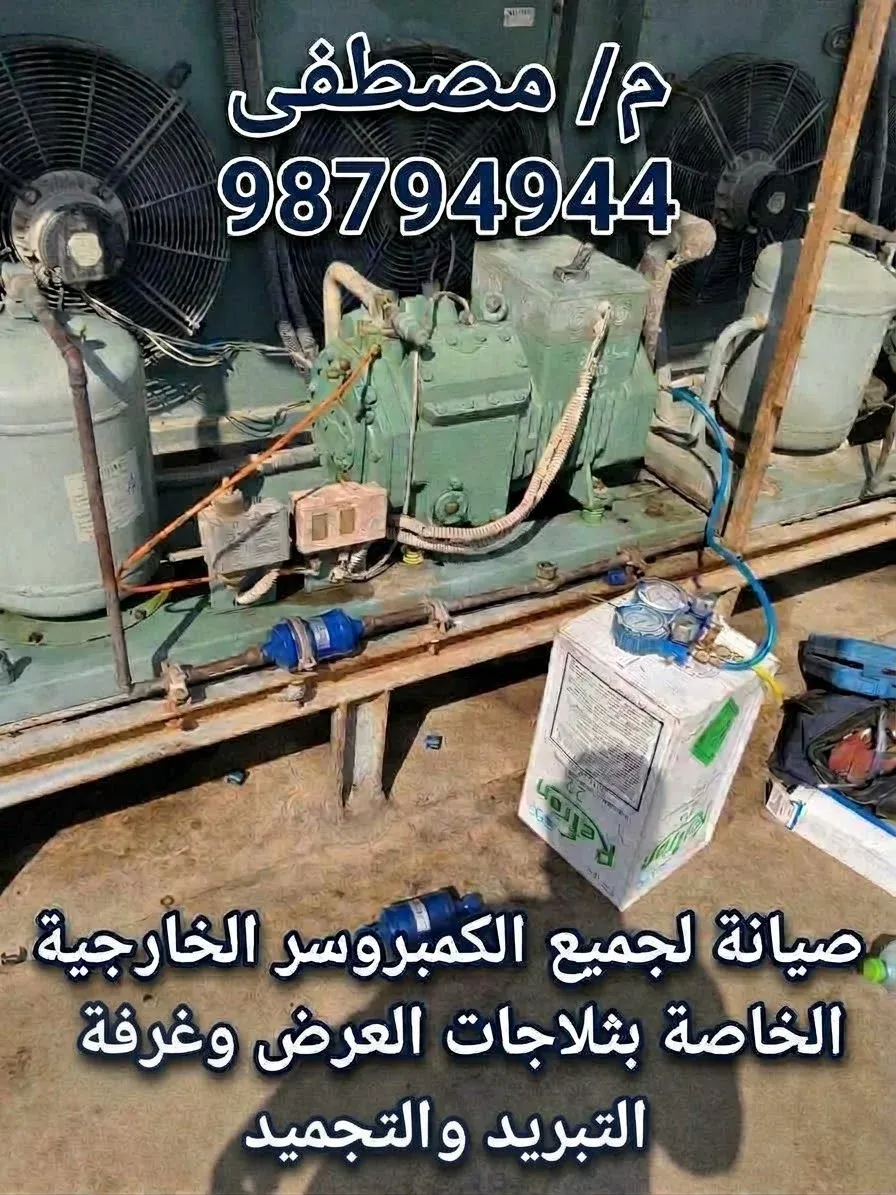
Choosing a condenser fan motor replacement technician requires attention to experience with commercial condensing units. Replacing the motor involves more than removing an old component and installing another of approximately the same size. The technician must understand electrical specifications, rotational speed, fan blade design, required airflow direction, unit location, and control arrangements. They must then verify that the replacement motor is suitable for the condenser and will not reduce the airflow required for correct operation.
In Kuwait, commercial cold room and freezer condensing units may be installed on rooftops, behind buildings, or in industrial areas exposed to dust and high temperatures. This makes motor mounting, environmental protection, and condenser cleanliness particularly important. The technician should also investigate whether another problem damaged the original motor, such as persistent mechanical rubbing, inadequate ventilation, or unsuitable electrical connections. Otherwise, the fault may return after replacement.
What Information Should the Technician Inspect?
-
Condensing unit manufacturer.
-
Motor model number.
-
Operating voltage and supply type.
-
Electrical power rating.
-
Rated current.
-
Rotational speed.
-
Required rotation direction.
-
Fan control type.
-
Shaft dimensions and mounting method.
-
Fan blade diameter and design.
-
Condition of the surrounding protective guard.
-
Environmental protection rating appropriate to the site.
-
Permitted operating temperatures.
-
Condition of contactors and electrical connections.
-
Condition of the air-cooled condenser itself.
Should the Technician Inspect the Old Motor?
Yes. Its nameplate helps identify a suitable replacement, and the cause of its failure may reveal another problem in the equipment.
Brand name alone is not sufficient without the model number and technical specifications.
Should the Condenser Be Inspected Before Installing the New Motor?
Yes. A dirty condenser or blocked airflow path may affect the unit's operating conditions even after a functioning fan has been installed.
Cleaning may be a separate maintenance task when the condenser's condition requires it.
Should the Technician Check Voltage?
Yes. An unsuitable electrical supply may affect motor operation and cause repeated faults.
Measurements should be performed safely by a qualified technician.
Is the Condenser Fan Motor Different from the Compressor Motor?
Absolutely. The fan motor moves air, while the compressor compresses refrigerant and circulates it through the refrigeration system.
Each component has different specifications, protective devices, and diagnostic procedures.
Can the Technician Install an Alternative Motor?
This may be possible if the replacement is approved and proven compatible with the unit's technical requirements.
Similarity in size or voltage alone is not sufficient to establish compatibility.
Does Installing a New Motor Require Replacing the Controller?
Not automatically. A compatible replacement may operate with the existing control system.
However, electronically controlled motors may require particular controllers or settings depending on the manufacturer.
What Indicates That the Repair Has Been Completed Correctly?
-
Stable fan rotation.
-
Airflow direction matching the equipment design.
-
No abnormal rubbing or vibration.
-
Operating current within specifications.
-
Correct response to controller commands.
-
No alarms related to the original fault.
-
Improved condenser heat rejection.
-
Stable compressor operation after appropriate testing.
Selecting a Condenser Fan Motor Replacement Technician
|
Evaluation Criterion |
Why It Matters |
|
Experience with commercial condensing units |
Identifies correct components |
|
Reviewing motor nameplate |
Selects compatible replacement |
|
Inspecting power supply |
Helps prevent recurring electrical faults |
|
Checking fan blades |
Confirms suitable airflow |
|
Understanding fan controls |
Avoids mistaking normal shutdown for failure |
|
Inspecting condenser |
Addresses poor heat rejection |
|
Measuring current |
Evaluates motor electrical load |
|
Reviewing condensing pressure |
Verifies the effect of repairs |
|
Explaining costs |
Clarifies parts and labor |
|
Documenting replacement |
Supports future maintenance |
Request a Condenser Fan Motor Inspection Before Replacement
If the outdoor fan is not spinning or the compressor keeps shutting down because of high pressure, prepare a photograph of the motor specifications, the condensing unit model, and any visible alarms.
A suitable technician identifies why the fan has stopped, matches the replacement motor to the equipment, and tests airflow and refrigeration performance rather than simply confirming that the motor rotates.
Freezer Room Condenser Fan Replacement Cost: Is It Different from Cold Room Maintenance?
Freezer room condenser fan replacement cost depends more on the specifications of the outdoor condensing unit than on the room temperature alone. A commercial freezer may use a larger condensing unit or different refrigeration arrangements from a small chilled storage room, but this does not automatically mean its fan motor will be more expensive. Costs vary with the number of fans, motor ratings, brands, control types, and availability of compatible components.
It is also important to distinguish the outdoor condenser fan from the evaporator fan inside the freezer room. They operate in different locations and perform different functions. The condenser fan helps remove heat outside the room, while the evaporator fan moves air and supports heat transfer from inside the room to the evaporator. Confusing these components when requesting spare parts may result in a quotation for the wrong item.
Is a Freezer Room Fan Motor More Expensive Than a Cold Room Fan Motor?
Prices may differ because of unit capacity and motor specifications, but there is no fixed price determined solely by the room's refrigeration category.
The specifications of each system's condensing unit must be reviewed.
Does the Number of Fans Affect Replacement Costs?
Yes, if more than one motor is damaged or the repair requires inspecting shared controls and a multi-fan assembly.
However, a unit having several fans does not mean all of them require replacement.
Is Replacing Only the Fan Blade Less Expensive?
It may cost less when damage is limited to the blade and the motor is still functional.
However, the replacement blade must be compatible, and equipment operation must be tested.
Is Condenser Cleaning Included in the Motor Replacement Price?
This depends on the quotation's scope. Condenser cleaning may be an additional service if its condition requires it.
All included work should be clarified before an agreement is made.
Is There a Difference Between Repairing and Replacing a Fan Motor?
Yes. Certain motors or accessories can be serviced, while other motors are sealed or uneconomical to repair.
The appropriate decision depends on equipment design, component condition, and the cost of the work.
Does a Rooftop Installation Affect the Cost?
Difficult access or the need for suitable safety equipment may increase the scope of work.
The location should be evaluated before confirming the final price.
Are Original Spare Parts Priced Differently?
Prices and availability may differ between original parts and compatible alternatives, but quality and suitability must be included in the comparison.
An incompatible component should not be installed merely to reduce costs.
Does a Failed Fan Mean the Compressor Must Also Be Replaced?
No, not automatically. The compressor may remain functional and may have stopped because high-pressure or thermal protection activated.
However, it should be evaluated if it has experienced abnormal operating conditions. Its condition should not be assumed without testing.
Freezer Room Condenser Fan Replacement Cost Factors
|
Cost Component |
Factors Affecting It |
|
Diagnosis |
Unit type and cause of shutdown |
|
Fan motor |
Brand, rating, and specifications |
|
Fan blade |
Diameter, design, and compatibility |
|
Electrical run capacitor, when installed |
Rating and specifications |
|
Contactor or protective device |
Component type and condition |
|
Removal and installation |
Accessibility |
|
Elevated access work |
Unit location and safety equipment |
|
Condenser cleaning |
Dirt accumulation and scope |
|
Electrical connection repairs |
Nature of damage |
|
Testing |
Electrical, airflow, and pressure measurements |
|
Warranty, when available |
Coverage and terms |
Freezer room condenser fan replacement costs depend on the spare part, installation location, and work required—not simply on whether the room is used for freezing rather than chilling.
Outdoor Condenser Fan Fault Diagnosis: Distinguishing Motor Failure from High Refrigeration Pressure

Outdoor condenser fan fault diagnosis must combine electrical inspection, mechanical assessment, and refrigeration system performance because a stationary fan may cause high condensing pressure, but it may also be stopped by the controller or another protective device. In some situations, the fan operates normally while the condenser is dirty or surrounded by hot air, producing symptoms similar to a fan failure.
The technician should therefore begin by establishing the operating sequence. Was the fan commanded to start? Did it receive the correct voltage? Did it rotate at the required speed? The technician then checks condenser fins, airflow paths, and discharge pressure when necessary. High pressure alone should not be treated as conclusive evidence of a defective fan motor because refrigerant charge, operating conditions, and other factors may also be responsible.
What Are the Steps in Diagnosing an Outdoor Condenser Fan Fault?
-
Record the condensing unit and motor specifications.
-
Review any displayed alarms.
-
Confirm whether a fan operating command is present.
-
Inspect the controller and staged fan operation.
-
Measure voltage and current using appropriate instruments.
-
Test the electrical run capacitor, when installed.
-
Inspect contactors, protective devices, and wiring.
-
Check the condition of fan blades and bearings.
-
Review condenser cleanliness.
-
Confirm that air intake and discharge paths are unobstructed.
-
Evaluate condensing pressure and operating conditions when necessary.
-
Identify the faulty component before approving replacement.
Does High Discharge Pressure Mean the Fan Is Defective?
No. Dirty condenser surfaces, inadequate ventilation, or other conditions may be responsible.
The fan, airflow, and refrigeration circuit should therefore be assessed together.
Can Dust Accumulation Reduce Condenser Performance Even When the Fan Works?
Yes. The fan may be rotating normally, but dirt on condenser fins can reduce heat transfer or obstruct airflow.
Simply confirming that the motor spins is therefore not enough.
Can a Condenser Fan Rotate in the Wrong Direction?
An incorrect rotation direction may occur because of unsuitable installation or wiring in certain systems.
The required airflow direction must be confirmed for the particular model rather than assuming a universal direction.
Is Low Fan Speed Always a Fault?
No. Some condensing units use electronic speed control to maintain appropriate condensing conditions.
However, rotation slower than required when full-speed operation is commanded may indicate a problem.
Does Inspection Include Bearing Noise?
Yes. Noise and vibration may indicate a mechanical problem.
However, bearing condition should be assessed through safe technical inspection rather than relying on sound alone.
Should All Fans Be Inspected in a Large Condensing Unit?
Yes. If the unit uses several fans, their combined operation and related controller commands should be reviewed.
One fan may be stopped normally during staged operation or may have an individual fault.
Condenser Fan and High-Pressure Fault Diagnosis
|
Inspection Result |
Possible Explanation |
Action |
|
No power reaches motor |
Control, wiring, or protection problem |
Repair circuit |
|
Correct power present but motor does not run |
Motor or starting fault |
Inspect components |
|
Rotation with vibration |
Blade, bearings, or mounting |
Mechanical repair |
|
Motor works but condenser is dirty |
Restricted heat transfer |
Appropriate cleaning |
|
High pressure despite normal fan operation |
Other condensing problems |
Continue diagnosis |
|
Normal staged operation |
Expected controller response |
Avoid unnecessary replacement |
|
Incorrect airflow direction |
Installation or wiring issue |
Correct according to manufacturer |
|
Abnormal motor current |
Load, electrical, or motor fault |
Comprehensive inspection |
Outdoor condenser fan inspection must establish whether the problem involves the motor, blades, power supply, or condensing system. Symptoms may look similar even when the necessary repairs and their costs are very different.
Commercial Condensing Unit Cooling Fan Installation: Required Specifications and Installation Mistakes
Commercial condensing unit cooling fan installation requires confirming that both the motor and fan blade are compatible with the condenser design and its required airflow. A replacement fan that rotates successfully is not necessarily suitable. Rotational speed, blade angle, or airflow direction may differ, affecting the condenser's ability to release heat.
Motor mounting, electrical connections, and protective devices must also be reviewed, particularly when the condensing unit is installed outside a building and exposed to dust, high temperatures, or humidity. Inadequate mounting may cause vibration or rubbing, while incorrect electrical connections may create operating faults. Installation must therefore follow manufacturer specifications and be performed by a qualified technician.
What Specifications Are Required Before Installation?
-
Condensing unit model.
-
Original fan motor part number.
-
Electrical supply type.
-
Motor power rating and current.
-
Rotational speed.
-
Required airflow direction.
-
Fan blade design and diameter.
-
Mounting arrangement.
-
Shaft dimensions and length.
-
Speed control type.
-
Electrical protective specifications.
-
Motor suitability for the installation environment.
Can a Larger Fan Blade Be Installed to Produce More Airflow?
Blade diameter or design should not be changed without an appropriate technical approval.
A larger blade may increase motor loading or be incompatible with the condenser housing.
Does Higher Fan Speed Always Mean Better Refrigeration?
Not necessarily. Increasing speed may change electrical load, noise, and airflow in unsuitable ways.
The correct speed must match the fan and condenser design.
Can a Different Fan Model Be Installed?
It may be possible when a technician confirms that the specifications are compatible and the alternative is approved.
Matching voltage and power alone is not enough. Mounting, fan blades, and control arrangements must also be assessed.
Does the New Motor Need a Run Capacitor?
This depends on the motor type and design. Some motors use a run capacitor, while others do not.
The wiring diagram specified for the component must be followed.
Should New Mounting Hardware Be Used?
This depends on the condition of the brackets, bolts, and manufacturer requirements.
Damaged or unsuitable mounting parts must be replaced.
Can the Fan Be Tested Outside the Condensing Unit?
Certain component tests may be performed using approved technical procedures. However, final testing must verify performance after the fan is installed within the unit's actual airflow arrangement.
Exposed or otherwise unsafe operation must be prevented.
What Installation Mistakes Should Be Avoided?
-
Installing a motor with unsuitable specifications.
-
Using an incompatible fan blade.
-
Ignoring the required airflow direction.
-
Failing to secure the motor properly.
-
Leaving the fan blade rubbing against the guard.
-
Installing unsuitable electrical wiring.
-
Bypassing a protective device.
-
Ignoring fan controller inspection.
-
Failing to clean a dirty condenser when cleaning is necessary.
-
Omitting appropriate pressure and refrigeration performance tests after repair.
Common Condenser Fan Installation Mistakes
|
Mistake |
Possible Consequence |
Correction |
|
Motor with unsuitable rating |
Incorrect load or performance |
Match specifications |
|
Different blade diameter |
Changes in airflow and load |
Select compatible blade |
|
Incorrect rotation direction |
Poor condenser performance |
Follow manufacturer instructions |
|
Loose mounting |
Vibration and noise |
Secure motor correctly |
|
Incorrect wiring |
Electrical faults |
Inspect circuit |
|
Ignoring speed control |
Unsuitable operation |
Verify compatibility |
|
Not inspecting condenser |
Heat rejection problem remains |
Clean or repair when necessary |
|
Skipping operating tests |
Original fault may remain |
Complete testing |
Installing a cooling fan in a commercial condensing unit must preserve the intended airflow and electrical design. Unapproved changes may cause unsuitable condensing pressure or excessive motor loading.
Replacing a Refrigeration Condenser Motor According to Its Rating: Choosing a Compatible Motor
Replacing a refrigeration condenser motor according to its rating involves more than matching the wattage printed on the nameplate. Motor power is only one of several specifications that determine suitability. Two motors with similar electrical ratings may have different rotational speeds, control methods, rotation directions, or blade mounting arrangements. The technician must therefore refer to the original component information and manufacturer specifications to identify an appropriate replacement.
Single-phase motors, three-phase motors, and electronically controlled motors also have different operating arrangements. Starting and protective circuits may vary from one design to another. A replacement motor should not be installed simply because it is available locally, has approximately the same dimensions, or is advertised as suitable for every refrigeration unit. Such comparisons may ignore essential operating characteristics.
Is Motor Wattage Enough to Choose a Replacement?
No. Wattage alone does not establish rotational speed or the airflow produced by the complete fan assembly.
All relevant technical specifications must be reviewed.
Is RPM Important for a Condenser Fan Motor?
Yes. Revolutions per minute influence blade performance and airflow according to blade design.
Higher rotational speed should not automatically be assumed to improve refrigeration.
Does the Electrical Motor Type Matter?
Yes. Alternating-current motors, electronically controlled motors, and different supply arrangements require suitable operating and control systems.
The motor type approved for the unit must be selected.
Does an Outdoor Fan Need Protection Against Dust and Moisture?
The motor's protection rating and construction materials should be appropriate for the installation environment according to manufacturer specifications.
This is particularly important when the outdoor unit is exposed to demanding weather and operating conditions.
Does Kuwait's Heat Mean a More Powerful Motor Should Be Installed?
Selection should follow the equipment design and approved operating limits rather than simply installing a higher-powered motor.
If the unit operates outside its permitted conditions, system suitability and ventilation should be addressed instead of changing motor power arbitrarily.
Must the Shaft Diameter Match?
Yes. When the fan blade attaches directly to the motor shaft, shaft dimensions, mounting method, and compatibility must be confirmed.
Unapproved differences may affect safety and vibration.
Can the Motor Mounting Bracket Be Modified?
Some approved replacement motors may require particular mounting accessories or arrangements.
However, modifications should not be made without technical evaluation of blade position, airflow, and mechanical protection.
Is Motor Efficiency Important?
Yes. However, it must be assessed alongside design requirements, energy performance, and component compatibility rather than in isolation.
Manufacturer specifications are the preferred basis for comparison.
Condenser Fan Motor Compatibility Checklist
|
Specification |
What Must Be Reviewed? |
|
Brand and model |
Original motor information |
|
Power rating |
Matches required specifications |
|
Voltage |
Compatible with electrical supply |
|
Frequency |
According to equipment design |
|
Electrical phases |
Single-phase, three-phase, or another system |
|
Rotational speed |
Suitable for fan design |
|
Control method |
Fixed or variable according to system |
|
Rotation direction |
Matches required airflow |
|
Shaft dimensions |
Compatible with fan blade |
|
Mounting method |
Suitable for unit housing |
|
Environmental protection |
Appropriate for installation location |
|
Permitted temperature |
Within operating conditions |
|
Fan blade |
Compatible diameter, pitch, and design |
|
Electrical connections |
According to wiring diagram |
|
Approved alternative |
Documented compatibility |
Replacing a condenser motor begins with its nameplate, but final selection requires matching speed, mounting, blades, electrical characteristics, controls, and operating requirements.
Commercial Condenser Fan Replacement Time: Service Steps, Cost, and Why Contact Us
Commercial condenser fan replacement time varies according to the condensing unit type, motor accessibility, availability of a compatible part, and whether additional components need repair. In some cases, the faulty motor is easy to identify and accessible after the unit has been safely isolated. Other situations may require removing a protective cover or an entire fan assembly, repairing damaged wiring, or correcting problems with mounting brackets.
The service duration is not determined solely by the time needed to remove the old motor and install the replacement. It also includes diagnosis, identifying a suitable replacement, safely isolating the electrical supply, checking fan blades, and carrying out operating tests. The refrigeration system may also need to be monitored under appropriate conditions to verify stable condensing pressure and compressor operation. A fixed repair duration or a guarantee that every job will be completed within a particular number of hours cannot therefore be provided without knowing the equipment model, installation location, and inspection results.
What Factors Determine Replacement Time?
-
Condensing unit brand and model.
-
Fan motor type.
-
Availability of a compatible replacement motor.
-
Accessibility of the outdoor unit.
-
Motor position within the housing.
-
Condition of the fan blade and mounting.
-
Presence of damaged electrical connections.
-
Need for contactor or controller repairs.
-
Number of affected fans.
-
Condenser cleaning requirements.
-
Required operating tests.
-
Safety conditions at the installation site.
Can the Motor Be Replaced During One Service Visit?
It may be possible when the diagnosis is clear, the correct component is available, and the location allows safe work.
However, some cases require special parts or additional testing, so the duration should be confirmed after inspection.
Does Replacing One Fan Take the Same Time as Replacing Several Fans?
Not necessarily. Fan quantity, location, control arrangements, and wiring may change the scope of work.
The failure of one fan does not mean all other fans must be replaced.
Does the Service Time Include Compressor Testing?
The scope of final testing should be agreed upon. Depending on the fault, it may include monitoring condensing unit operation, operating pressures, and refrigeration performance.
The important objective is to verify that the original problem has been addressed rather than merely confirming that the fan rotates.
Does the Cold Room Need to Be Shut Down for a Long Time?
Downtime varies according to the required procedures and components. Appropriate arrangements must be made to keep products within their required storage conditions.
A safe storage duration cannot be guaranteed without knowing temperatures, product load, and storage conditions.
Can the Motor Be Replaced Without Changing the Refrigerant?
In many air-cooled condensing units, the fan motor can be replaced without opening the refrigerant circuit.
However, this depends on equipment construction and the specific work involved. The technician must determine the correct approach.
Is There a Fixed Condenser Fan Replacement Price in Kuwait?
No. The final cost varies according to the motor type, fan blade, condensing unit, installation work, and testing.
The price should be established after confirming specifications and diagnosis rather than relying on unsupported general figures.
Is There a Warranty on the New Fan?
Warranty availability depends on the component supplier, service provider, and agreed scope of work.
Coverage, duration, and exclusions should be requested in writing when available. Comprehensive coverage should not be assumed.
Condenser Fan Replacement Service Steps
Receiving the Fault Description: Determine whether the fan is stationary, running weakly, making unusual noises, or causing an alarm.
Recording Equipment Information: Identify the condenser model and the motor and fan blade specifications.
Inspecting Controls and Electricity: Review operating commands, electrical supply, and related components.
Identifying the Cause: Confirm whether the fault is in the motor, blade, or another component.
Choosing the Replacement: Match specifications with an approved compatible part.
Preparing a Quotation: Explain the component cost, labor, and any additional repairs.
Securing the Work Area: Isolate energy sources and review safety procedures.
Removing the Damaged Component: Remove the motor or blade as required.
Installing the Replacement: Secure and connect the motor according to the equipment design.
Inspecting the Fan Assembly: Check for rubbing or abnormal vibration.
Testing Operation: Review rotation, current, and airflow.
Monitoring Unit Performance: Confirm stable refrigeration conditions and no recurrence of the fault.
Documenting the Work: Record the replacement component, maintenance notes, and warranty terms when available.
Factors Affecting Replacement Time and Cost
|
Item |
Effect on Service Time |
Effect on Price |
|
Diagnosis |
Requires appropriate inspection time |
Diagnostic labor |
|
Motor availability |
May affect completion |
Component price |
|
Unit location |
May require special access arrangements |
Labor and access equipment |
|
Fan blade type |
Affects removal and installation |
Replacement cost if needed |
|
Electrical connections |
May require additional repair |
Parts and labor |
|
Fan control system |
Requires compatibility testing |
Additional inspection work |
|
Number of fans |
Changes the service scope |
Components and labor |
|
Condenser cleanliness |
May require cleaning |
Additional work when necessary |
|
Final testing |
Requires verification time |
Depends on agreed testing scope |
|
Follow-up |
According to agreement |
According to service terms |
What Should You Look for in a Condenser Fan Replacement Provider?
|
Selection Criterion |
Benefit for the Shop Owner |
|
Diagnosis before replacement |
Avoids replacing a functioning motor |
|
Matching component specifications |
Ensures motor compatibility |
|
Electrical inspection |
Identifies causes of recurring failure |
|
Blade and mounting inspection |
Helps reduce vibration |
|
Airflow assessment |
Supports condenser performance |
|
Current measurement |
Evaluates electrical loading |
|
Condensing pressure inspection when needed |
Helps assess compressor shutdown causes |
|
Detailed quotation |
Clarifies expenses |
|
Testing after installation |
Verifies repair performance |
|
Documenting parts and labor |
Supports future maintenance |
|
Written warranty when available |
Clarifies responsibilities |
Why Contact Cold Room and Display Refrigerator Maintenance?
Through Cold Room and Display Refrigerator Maintenance in Kuwait, you can inquire about outdoor condenser fan inspections, fan motor or blade replacement services according to the unit type, and the availability of suitable components and services.
Providing motor specifications, the condensing unit model, and a description of the fault can help establish the required service scope, cost, and duration based on clear technical information. Part availability and applicable warranty conditions should be confirmed before agreeing to the work.
What Information Should You Prepare Before Requesting Service?
-
Shop or restaurant location in Kuwait.
-
Whether the equipment serves a chilled room or freezer room.
-
Condensing unit brand and model.
-
Photograph of the fan motor nameplate.
-
Whether the fan has stopped completely.
-
Whether it is rotating slowly.
-
Whether unusual noise or vibration is present.
-
Whether the compressor keeps shutting down.
-
Whether a high-pressure alarm appears.
-
Whether the condenser is dirty.
-
Whether the unit has multiple fans.
-
Whether the outdoor unit is installed on a rooftop or other elevated location.
-
Whether the motor or fan blade was replaced previously.
-
Whether products require alternative storage during repairs.
Request Condenser Fan Inspection Before Replacement
If the outdoor fan is not spinning, the motor makes unusual noises, or the compressor shuts down with high-pressure indications, prepare the equipment information and fault symptoms. Request an inspection to establish whether the motor or blade needs replacement or whether electrical and control repairs are required.
Correct replacement involves confirming the fault, choosing compatible components, performing safe installation, and testing refrigeration performance. A rotating fan does not necessarily produce the airflow required by the condensing unit.
Frequently Asked Questions About Condenser Fan and Motor Replacement in Kuwait
Why Is the Outdoor Condenser Fan Not Spinning While the Compressor Is Running?
Possible causes include a defective fan motor, electrical run capacitor when installed, contactor, electrical supply, or controller. In some systems, the fan may also be stopped normally during staged operation. Operating commands, connections, and motor condition must be inspected before replacing it.
How Much Does a Commercial Condenser Fan Motor Cost in Kuwait?
Prices vary according to brand, power rating, voltage, rotational speed, control method, fan blade specifications, and compatibility with the unit. Removal, installation, and testing may be charged separately. A more accurate price can be determined after confirming the equipment model and required motor specifications.
Can a Failed Condenser Fan Cause the Compressor to Shut Down?
Yes. If a fan required for condenser cooling stops, condensing pressure may increase and activate the high-pressure switch or another protective device. However, the actual shutdown cause must be confirmed rather than assuming the fan is solely responsible without inspecting the rest of the system.
How Long Does Commercial Condenser Fan Replacement Take?
The duration depends on unit accessibility, motor type, replacement part availability, electrical wiring, mounting condition, and required tests. Some repairs may be completed during one visit, while others need special components or additional work. A fixed duration cannot be established for every system before diagnosis.
Do I Need to Replace Both the Motor and Fan Blade?
Not always. If the motor is defective but the existing blade is undamaged and compatible with the replacement motor, the blade may be reused. If the blade is damaged but the motor is functioning properly, only the blade may require replacement. The technician should decide after inspecting the components and reviewing their specifications.
Conclusion: Condenser Fan and Motor Replacement in Kuwait at the Right Cost and Service Time
If your outdoor condenser fan has stopped, is rotating slowly, or is producing unusual noises, do not replace the motor before confirming the cause. The fault may involve the motor itself, fan blades, electrical run capacitor, contactor, or controller. In some units, a stationary fan may also be part of normal operating controls. Refrigeration condenser fan replacement in Kuwait therefore requires proper diagnosis to identify the damaged component and select a suitable replacement.
Whether you are searching for commercial condenser fan motor prices, need cold room condensing unit fan replacement, or want to understand freezer room condenser fan replacement costs and commercial condenser fan replacement time, the correct decision depends on brand, model, motor type, and installation location. The condenser, ventilation, and operating pressures should also be assessed to ensure the original fault has been addressed.
Through Cold Room and Display Refrigerator Maintenance in Kuwait, you can inquire about commercial condenser fan inspections, available repair and replacement services, and suitable components, while clarifying the work scope, prices, expected duration, and warranty conditions before agreeing to proceed.
Is your condenser fan not spinning? Does the motor overheat and shut down? Or does the compressor stop because of high refrigeration pressure?
Prepare a photograph of the fan motor nameplate and the condensing unit model. Explain whether the problem involves rotation, noise, or vibration, and request an inspection that identifies the necessary component before approving replacement.
For inquiries about condenser fan and motor replacement in Kuwait:
Technical and Safety Note: Electrical supply inspections, run capacitor testing, contactor checks, and motor servicing must be carried out by qualified technicians. All relevant energy sources must be isolated, and moving components secured before maintenance. Pressure switches and other protective devices must never be bypassed. A condensing unit without the required airflow must not be forced to operate. Motor specifications, fan blades, and airflow direction must match manufacturer requirements, and stored product temperatures should be monitored whenever refrigeration is interrupted during maintenance.