Cold Room Relocation in Kuwait: Dismantling, Costs and Time
·
Cold Room and Freezer Relocation in Kuwait: Costs and Time Before Moving Your Business
If you have decided to relocate your restaurant, grocery store, or food warehouse to a new location, you will naturally start thinking about which equipment can be reused, particularly your cold room or freezer room.
This raises an important question about cold room and freezer dismantling and relocation in Kuwait: How much does it cost, how long does the process take, and can the room be reinstalled without damaging its insulation or compressor?
Direct answer: Many cold rooms and freezer rooms can be dismantled, transported, and reassembled, especially systems constructed from modular panels designed for assembly and disassembly.
However, whether relocation is possible depends on the condition of the panels, connections, flooring, doors, and refrigeration equipment, as well as whether the existing room is suitable for the new premises.
The cost and duration can only be determined after inspecting both locations and assessing the dismantling, transportation, reinstallation, and recommissioning work.
An important point is that moving a cold room is not the same as transporting an ordinary refrigerator.
A cold room consists of an insulated enclosure, condensing unit, evaporator, refrigeration pipes, electrical connections, and controls. Some components may require technical disconnection, refrigerant recovery, and appropriate protection before transportation.
Installation manuals for modular cold rooms explain that insulated panels may use mechanical connections known as Cam-Lock fasteners, together with sealing gaskets. Dismantling and reassembling these panels must take account of the manufacturer's assembly system and the condition of the connections.
Copeland technical guidance also emphasizes the importance of safely handling refrigerants and electrical systems before dismantling refrigeration circuit components.
In Kuwait, relocation may become more complicated if the outdoor refrigeration unit is installed on a rooftop, if the new premises require longer refrigeration piping, or if the new warehouse floor has not been prepared.
You must also consider the products stored in the cold room, since the relocated room may require an operating and testing period before it is suitable for storing food again.
In this guide from Cold Room and Display Refrigerator Maintenance, we explain cold room dismantling and relocation costs, the expected duration and factors affecting it, and how insulated sandwich panels, compressors, and evaporators should be handled.
We also explain when existing components can be reused, when replacement may be preferable, and how to request a site inspection and a clear quotation.
Cold Room and Freezer Relocation in Kuwait: What Does the Complete Service Include?
When searching for cold room and freezer dismantling and relocation in Kuwait, some business owners expect the process to involve removing the insulated panels, loading them onto a vehicle, and assembling them again at the new location.
However, the process involves much more because a cold room contains structural, mechanical, and electrical components that must be disconnected, transported, and reassembled in an appropriate sequence.
Reinstalling the existing components also does not guarantee successful operation unless the new location, cooling load, electrical requirements, and ventilation conditions have been assessed.
What Does a Cold Room Dismantling and Relocation Service Mean?
It refers to a series of operations intended to move an existing cold room from one location to another while assessing whether its components can be reused and then installed and operated at the new premises.
The service may include inspecting both locations, documenting components, disconnecting equipment, dismantling insulated panels, and protecting them during transportation.
It may also include rebuilding the insulated enclosure, installing refrigeration pipes and electrical connections, and performing operational tests.
However, the actual service scope must be stated in the quotation because some offers cover dismantling and transportation only, without recommissioning.
Can a Cold Room Be Moved Without Dismantling It?
That depends on the room type, construction method, dimensions, access routes, and available transportation equipment.
Some small integrated units may be transported as a complete assembly if the manufacturer permits it and the procedure can be performed safely.
Large cold rooms constructed from sandwich panels, however, may require the panels and refrigeration equipment to be dismantled.
A complete room should never be lifted without assessing its lifting points, weight, and structural safety.
Is Moving a Freezer Room Different From Moving a Cold Room?
Yes. Freezer rooms may have special arrangements for flooring, insulation, defrosting, and heating particular components, depending on their design.
Their operating requirements and target temperatures also differ from ordinary chilled cold rooms.
Relocation may affect insulation connections, vapor barriers, and door equipment.
The original design must therefore be reviewed before the dismantling method is determined.
Should Both the Old and New Locations Be Inspected?
It is preferable to inspect both locations before providing a final quotation.
The existing location reveals the condition of the panels and equipment and how they are installed, while the new premises determine whether reinstallation is possible.
The room dimensions may be suitable, but the ceiling height, door position, or condensing unit location may be different.
Additional requirements for flooring, electricity, or ventilation may also become apparent.
Does the Service Include Electrical Disconnection?
The work may include disconnecting the cold room's electrical connections through a qualified specialist.
However, preparing a new electrical supply point or installing additional cables may be charged separately.
Electrical power must be disconnected and secured against unintended operation before the relevant work begins.
Copeland instructions emphasize the importance of properly disconnecting and securing electrical power before servicing compressor components.
Must the Refrigerant Be Handled Before Transportation?
That depends on the system design, whether components can be isolated, and the dismantling work required.
The process may involve recovering refrigerant with suitable equipment before opening the circuit.
Refrigeration pipes containing refrigerant must not be cut or handled without appropriate precautions.
Safety procedures also differ according to the refrigerant's characteristics, particularly when the substance is flammable.
Does Relocation Include Shelving, Doors, and Lighting?
These components may be included in the service scope if agreed upon.
However, some shelving may be installed independently or unsuitable for the new premises.
The door, gaskets, lighting, and electrical connections must also be inspected.
It is preferable to prepare an inventory identifying which components will be transported and which require replacement.
Can a Cold Room Be Moved While It Contains Products?
Moving the cold room itself should not be treated as a method of transporting refrigerated products without separate arrangements to preserve them.
Disconnecting the refrigeration system and dismantling the room may take enough time to expose products to unsuitable temperatures.
The room should be emptied, and products should be transported or stored using appropriate alternative refrigeration.
Food safety must also be assessed according to storage temperatures and exposure times, rather than assuming that returning food to refrigeration makes it safe again.
What Are the Main Stages of the Service?
The stages you should ask about include:
-
Inspecting the existing cold room.
-
Measuring the available space at the new location.
-
Checking the condition of panels, doors, and flooring.
-
Reviewing the compressor, evaporator, and condenser.
-
Identifying electrical and mechanical work.
-
Preparing a plan to protect stored products.
-
Disconnecting and securing refrigeration equipment.
-
Dismantling the enclosure and labeling components.
-
Packaging equipment and loading it.
-
Transporting everything to the new location.
-
Preparing the flooring and piping routes.
-
Reassembling the enclosure and equipment.
-
Testing insulation integrity and refrigeration circuit tightness.
-
Recharging refrigerant when required, according to specifications.
-
Testing operation and temperature performance.
-
Completing handover with details of the work and warranty.
Does Reinstallation Mean the Room Will Operate at the Same Efficiency?
Not necessarily. Performance is affected by the new location, outdoor temperature, refrigeration piping length, product arrangements, and the condition of reused components.
The condensing unit, evaporator, or controls may require modifications.
The suitability of the entire system must therefore be assessed before relocation.
If you want to dismantle and relocate a cold room or freezer room in Kuwait, request a quotation that includes an assessment of the new location and equipment condition, not simply the cost of removing and loading insulated panels.
Cost of Moving a Cold Room From One Shop to Another: What Affects the Price?
When asking about the cost of moving a cold room from one shop to another, you may receive very different quotations.
Some providers calculate the cost of transporting the insulated enclosure only, while others include electrical work, the compressor, evaporator, and recommissioning.
You should therefore not compare two prices without knowing exactly what each quotation includes.
Direct answer: Relocation costs depend on the room's dimensions, panel condition, assembly system, access difficulties at both sites, transportation distance, and lifting equipment. They also depend on the work required to disconnect and reinstall the refrigeration system and electrical connections and to carry out operational testing.
Is There a Fixed Price for Cold Room Relocation in Kuwait?
There is no reliable fixed price that applies to every cold room.
A small room designed for dismantling differs from a large commercial cold room containing several evaporators.
Moving equipment between two ground-floor shops may also differ from moving it between a rooftop, basement, and another warehouse.
A site inspection or detailed project information should therefore be provided before a final price is issued.
Does Room Size Determine the Relocation Cost?
Size is important because it affects the number and weight of panels, work duration, and transportation space required.
However, size alone is not sufficient.
A small room may contain complicated refrigeration equipment, while a larger room may have modular panels that are relatively easy to disconnect.
The condition of the connections and the installation method also play important roles.
Does the Distance Between the Two Shops Increase the Cost?
Distance may affect transportation charges, loading arrangements, and the number of journeys.
However, it is not the only factor because accessing equipment inside a building may be more difficult than the journey between locations.
Some premises may also require lifting equipment or coordination with building management.
Access conditions must therefore be included in the quotation.
Is Moving a Ground-Floor Cold Room Cheaper?
It may be easier if there is a wide entrance and a direct loading route, but the floor level alone cannot establish the price difference.
There may be obstacles, steps, or narrow corridors even on the ground floor.
Upper-floor locations may require suitable lifting equipment.
The decision depends on the inspection and handling plan.
Does Panel Condition Affect the Cost?
Yes. Some panels may require repair or replacement before they can be reused.
Gaskets and assembly connections may also be damaged during dismantling.
Joint areas may require new sealing materials.
The reusable components should therefore be identified rather than assuming that every panel can be used again.
Is Condensing Unit Transportation Included in the Price?
Not always.
The unit may require lifting equipment, disconnection of refrigerant pipes and electrical connections, and removal of mounting supports.
The new location may also need new foundations, brackets, or piping.
Disconnecting, transporting, and reinstalling the condensing unit must therefore be explicitly included in the quotation.
Is Refrigerant Recharging Charged Separately?
That depends on the work required, circuit condition, and refrigerant type.
Opening the refrigeration circuit may require recovery of the refrigerant, followed by testing and preparation before recharging.
Other systems may involve different procedures depending on isolation arrangements and manufacturer instructions.
The cost of refrigerant, testing, and materials must therefore be clarified if they form part of the relocation.
Does Changing the Door Location Increase the Cost?
It may increase the work if repositioning the door is technically possible but requires rearranging panels or adding components.
In some rooms, the door is installed within a specially manufactured panel that cannot easily be moved to another position.
Modifications may require replacing panels rather than cutting them arbitrarily.
The new layout must therefore be approved before dismantling begins.
Factors Affecting the Cost of Cold Room Relocation
|
Cost item |
What affects the cost? |
What should you ask before approval? |
|
Site inspection |
Number of locations and equipment condition |
Is inspection included? |
|
Panel dismantling |
Number of panels and connection types |
Does it include labeling and protection? |
|
Door removal |
Door type and installation |
Is realignment included? |
|
Equipment disconnection |
Number of units and connection methods |
Are the compressor and evaporator included? |
|
Refrigerant handling |
System type and disconnection procedures |
Are recovery and recharging included? |
|
Transportation |
Distance, load, and number of journeys |
Are vehicle and loading charges included? |
|
Lifting |
Equipment height and accessibility |
Is additional lifting equipment necessary? |
|
New premises |
Flooring and dimensions |
Is site preparation included? |
|
Piping |
Length, condition, and modifications |
Will any sections be replaced? |
|
Electrical work |
Supply, cables, and controls |
Who prepares the electrical connection? |
|
Insulation |
Gaskets, joints, and materials |
Are repairs included? |
|
Testing |
Leak-tightness and operation |
Will testing be completed before handover? |
|
Warranty |
Work and components |
What is covered, and what is excluded? |
How Can You Obtain a Clear Quotation?
Send the cold room dimensions and safe photographs of the panels, door, and equipment identification plate, together with both locations, floor levels, and details about elevators or loading access.
Then request a clear explanation of what is included and excluded.
If you want to know the price of moving a cold room between shops in Kuwait, compare the total cost from dismantling through recommissioning, not merely the transportation vehicle charge.
Cost of Dismantling a Commercial Freezer Room: Why Do Freezer Rooms Require Additional Care?
When calculating the cost of dismantling a commercial freezer room, you need to understand that freezer rooms may differ from ordinary cold rooms in their flooring, insulation, doors, defrost systems, and piping arrangements.
It would therefore be inaccurate to price the dismantling of a freezer room according to the number of panels alone, because the process may include additional components that require inspection before and after relocation.
Reusing components that previously operated at very low temperatures also requires confirming the integrity of insulation, connections, and vapor barriers.
Is Dismantling a Freezer Room More Expensive Than Dismantling a Cold Room?
It may cost more if the freezer room contains additional equipment or requires more complicated work.
However, not every freezer room is more expensive to dismantle than every cold room.
A small freezer room may be easier to dismantle than a large chilled warehouse with multiple refrigeration units.
The project's actual dimensions and components must therefore be compared.
Does a Freezer Room Floor Require Special Dismantling?
Some freezer rooms may have insulated flooring and systems designed to prevent problems caused by freezing beneath the floor, depending on the original design.
Certain components may be incorporated into the building rather than being easily transportable.
Insulation layers and vapor barriers may also be damaged during removal.
It is therefore necessary to determine what can be transported and what must be reconstructed.
Can Freezer Room Flooring Be Reused?
That depends on the flooring type, installation method, and condition.
Modular floor panels designed for dismantling may be reusable if they are undamaged and suitable for the loads at the new location.
However, floors constructed as permanent structural layers may not be transportable in the same way.
Insulation, finishing materials, and load capacity must be inspected before making a decision.
Does the Freezer Room Door Need Special Protection During Transportation?
Yes. The door is an essential part of the room's thermal insulation and sealing system.
Depending on its type and operating temperature, it may contain special components.
Damage to the frame or gaskets may allow warm air and moisture to enter.
The door and its accessories must therefore be protected, and its closure must be inspected after reinstallation.
Can Door Heaters Be Affected During Relocation?
If the room contains heaters in the door frame or other components, their connections must be documented, disconnected, and reconnected according to the original design.
Wires and connection points may be damaged if they are dismantled carelessly.
These components must also be tested before final operation.
However, door heaters should not be assumed to be present in every freezer room.
Does the Defrost System Need Modification?
It may require reassessment if the evaporator, its position, or the operating conditions change.
Defrost sensors, drainage, and any heaters connected to the system must also be inspected.
The appropriate settings may differ at the new location.
Reconnecting the wiring and accepting the previous settings without testing is therefore not sufficient.
Can an Old Commercial Freezer Room Be Moved Into a Larger Warehouse?
This can be assessed, but the old refrigeration equipment may not have sufficient capacity if room dimensions or product quantities increase.
Cooling loads also change according to insulation, door frequency, and the temperature of incoming products.
A different refrigeration unit or design modification may therefore be required.
The room should not be enlarged simply because the compressor performed well at its previous location.
Must Freezer Refrigeration Pipes Be Replaced After Relocation?
Some sections may require replacement because of changes in routing or damage during dismantling.
Pipe diameters, insulation, line lengths, and height differences must also be reviewed according to manufacturer instructions.
Reusing every existing pipe may not be appropriate.
Long piping extensions should not be added without technical evaluation based solely on the original pipe diameters.
What Affects the Cost of Dismantling a Freezer Room?
|
Component |
Why it affects the cost |
What needs reviewing |
|
Insulated panels |
Quantity, thickness, and assembly method |
Whether they can be dismantled and reassembled |
|
Freezer flooring |
Insulation type and installation |
Whether it can be relocated |
|
Freezer door |
Frame, gaskets, and accessories |
Closing and sealing condition |
|
Door heaters |
Presence and connection method |
Electrical integrity |
|
Evaporator |
Weight and defrost system |
Removal and mounting requirements |
|
Condensing unit |
Location and weight |
Lifting requirements |
|
Refrigeration pipes |
Length, insulation, and mounting |
Which parts can be reused |
|
Controls |
Sensors and control panel |
Testing after relocation |
|
New materials |
Gaskets, seals, and piping |
Additional costs |
What Should Be Done Before Dismantling a Commercial Freezer?
Request a preliminary assessment explaining the room's condition and identifying which components can be reused, along with any work required at the new premises.
An appropriate plan must also be prepared to protect frozen products while the system is unavailable.
If you need to dismantle a commercial freezer room in Kuwait, do not compare dismantling prices alone. Review the costs of flooring, insulation, freezer-specific components, and recommissioning.
Moving and Reinstalling a Cold Room: The Correct Steps From the Old Shop to the New Location
Moving and reinstalling a cold room requires a clear sequence of work so the project does not become a collection of separate tasks with unclear responsibilities.
One contractor may dismantle the panels, another may transport them, and a third technician may reconnect the compressor. If an insulation or piping problem then appears, each party may claim that another contractor is responsible.
It is therefore preferable to define the installation stages, responsibilities, and tests before relocation begins.
Step One: Inspect the Cold Room Before Dismantling
The assessment begins by identifying the room dimensions, components, and assembly system.
The condition of the door, flooring, compressor, evaporator, and control panel is also reviewed.
It is useful to establish whether the room was achieving the required temperature before the relocation decision.
If a cooling problem already existed, it should be documented so that it is not automatically attributed to the relocation later.
Step Two: Inspect the New Premises
The new location is measured, taking into account panel thickness, ceiling height, and access routes.
The flooring, electrical supply, and condensing unit location are also reviewed.
The door position or opening direction may need to change.
Relocation should not be approved before confirming that the room can be installed properly.
Step Three: Protect the Stored Inventory
The method of removing products and transporting or storing them under suitable conditions is established.
The restaurant or warehouse may need temporary alternative refrigeration for sensitive products.
Product condition and temperatures must also be documented according to the establishment's procedures.
Dismantling should not begin while food products are still inside the room.
Step Four: Safely Disconnect Electricity and Refrigeration Equipment
Electrical power is disconnected and secured against unintended operation.
A qualified technician then handles the refrigerant circuit according to the required disconnection procedure and safety requirements.
The work may involve recovering refrigerant using specialized equipment.
Copeland guidance warns against opening refrigeration circuits or performing hot work while refrigerant remains present without the necessary precautions.
Step Five: Document and Label the Components
It is preferable to photograph the original arrangement and record the positions of panels, connections, doors, and electrical cables.
Components that must be reassembled in a particular sequence should be clearly labeled.
Small components and fasteners should also be kept in organized containers.
This stage helps reduce mistakes during reinstallation.
Step Six: Dismantle the Enclosure and Equipment
The panels are dismantled according to the assembly method specific to the system.
Separate equipment is then handled using lifting and moving methods suitable for its size and weight.
Panel edges and surfaces must be protected against impact and bending.
Tools or dismantling methods that could damage the locking mechanisms or insulation must not be used.
Step Seven: Package and Load the Components
Panels, doors, and equipment are protected against friction, falling, and moisture during transportation.
The load must also be arranged according to the characteristics of its components.
Some cold room manufacturer instructions emphasize the importance of protecting sensitive panel edges and preventing damage from impact and moisture.
It must not be assumed that every component can be loaded or transported using the same method.
Step Eight: Prepare the New Location
The floor is inspected for levelness, dryness, and load-bearing capacity.
The positions of the walls, door, and refrigeration equipment are then established according to the layout.
Electrical preparation, supports, or openings for refrigeration piping may be required.
Any differences between the new location and the approved design should be addressed before panel assembly.
Step Nine: Reassemble the Panels and Equipment
Undamaged panels are assembled according to the manufacturer's system, with attention to alignment, joints, and gaskets.
The door is then installed and checked for correct opening and closing.
The condensing unit, evaporator, pipes, and electrical connections are also installed according to the design.
Some components may need replacement if damage is identified during inspection.
Step Ten: Test Operation and Complete Handover
The refrigeration circuit undergoes the appropriate technical tests after reconnection.
Controls, fans, and protective devices are also reviewed.
Room temperature and operating stability are then monitored before products are returned.
Important: Successful compressor operation alone is not enough to demonstrate that the cold room is ready after relocation.
What Should You Receive After the Cold Room Has Been Moved?
It is preferable to receive:
-
A list of the components transported.
-
A list of replaced parts.
-
An explanation of additional work completed.
-
Information about the room and its equipment.
-
Results of the necessary leak-tightness tests.
-
Confirmation that insulation and door condition were reviewed.
-
Operating test and temperature monitoring results.
-
Maintenance and follow-up instructions.
-
An itemized invoice.
-
Warranty conditions for the work, where applicable.
If you want to move and reinstall a cold room, request a plan that covers dismantling, transportation, installation, and operational testing, so the project remains clear from the first step through handover.
Cold Room Sandwich Panel Dismantling Technician: How Can Insulation Be Protected During Relocation?

If you need a technician to dismantle cold room sandwich panels, choosing the correct dismantling method is just as important as selecting transportation equipment.
These panels are not simply metal sheets that can be removed and reinstalled in any manner.
Each panel contains insulating material, protective surface layers, and connections. The room may also have mechanical locking systems and sealing gaskets.
Damage to the edges or joints may affect the quality of reassembly, even when the outer surface appears undamaged.
Can Every Sandwich Panel Be Dismantled?
No. Panel installation methods differ according to the manufacturer and design.
Some cold rooms use modular panels with releasable locking mechanisms, while others have fasteners or connections that require different procedures.
Certain sections may also be permanently attached or incorporated into structural work.
The assembly system must therefore be identified before dismantling begins.
What Is the Cam-Lock System in Cold Rooms?
Cam-Lock is a type of mechanical connection used in certain modular cold rooms to fasten panels together securely.
These connections may work together with gaskets that help reduce air leakage.
Some manufacturers' installation manuals explain that panels have specific positions and assembly sequences, and that overtightening the locks can damage their fastening mechanisms.
However, the correct method for handling these locks depends on the manufacturer's instructions and must not be generalized to all panel systems.
Can Panels Be Dismantled Without Breaking Them?
This may be possible when the connections are designed to be released and the panels are in suitable condition.
However, older panels may have suffered damage from moisture, corrosion, or previous repairs.
Some joints may also have been sealed with materials that are difficult to remove without affecting the surfaces.
All panels should therefore not be guaranteed reusable before they have been inspected.
Is Labeling the Panels Necessary?
Labeling is useful, particularly when panel dimensions or locking positions differ.
A particular panel may have been manufactured for the door, ceiling, or a corner.
Labeling also helps the components be reassembled according to the original design.
Some manufacturers' instructions emphasize the importance of matching panel identification marks with the assembly drawings.
Can Panels Be Damaged if They Bend During Loading?
Improper handling may damage surface layers, connections, or insulation material.
Such damage may appear as bending or deformation around the edges.
Panels must therefore be moved using suitable support methods while avoiding pressure on sensitive corners.
They should not be dragged across the floor or subjected to impacts during loading.
Can Old Gaskets Be Reused?
That depends on their condition, type, and installation method.
Some gaskets may remain flexible and undamaged, while others require replacement because of cuts, compression damage, or deterioration.
Joint sealing must also be reviewed after reassembly.
Damaged gaskets should not be reused simply to reduce relocation costs.
Can a Panel Be Cut to Fit the New Location?
Certain systems may permit carefully planned modifications, but arbitrary cutting can damage connections, expose insulation, or affect structural strength and sealing.
Integrated locking mechanisms along panel edges may also make dimensional changes impractical.
The manufacturer's design and permitted modifications must therefore be reviewed before any decision is made.
Purchasing a new panel may be more suitable than modifying an existing one incorrectly.
Can the Door Be Moved to a Different Panel Location?
That depends on the type of cold room.
Some modular systems allow certain door configurations, while custom-built rooms may contain panels specifically manufactured for the existing door location.
Rearrangement may require modifying the door frame or replacing an entire panel.
The door must not be assumed to be movable to any wall without technical assessment.
Can New Sealing Materials Be Used After Relocation?
Some sealing materials may need replacement or renewal according to the design and condition of the joints.
The materials must be suitable for the operating temperatures, environment, and intended use.
Sealing work must also avoid trapping moisture in unsuitable locations.
The objective is to restore the insulation and sealing functions according to the cold room specifications.
What Should the Technician Check Before Reinstalling the Panels?
The following should preferably be reviewed:
-
Condition of the metal surface coating.
-
Straightness of panel edges.
-
Absence of swollen or visibly damaged areas.
-
Condition of the insulation core.
-
Locking mechanisms and fasteners.
-
Integrity of sealing gaskets.
-
Compatibility of dimensions with the new location.
-
Positions of door and corner panels.
-
Condition of ceiling panels.
-
Flooring or support-base condition.
-
Service penetration points.
-
Ability to create properly sealed joints.
When Is Panel Replacement Preferable?
Replacement may be appropriate when panels are severely damaged, have lost their ability to seal properly, or are incompatible with the new layout.
The cost of repair and relocation should also be compared with a suitable new alternative.
If you need a technician to dismantle cold room sandwich panels in Kuwait, make sure the inspection covers insulation and connection integrity and that the dismantling and packaging methods suit the particular cold room system.
Moving Freezer Room Compressors and Evaporators: What Precautions Protect the Equipment?
Transporting a freezer room compressor and evaporator requires a different technical assessment from dismantling the insulated enclosure.
These components are connected to a pressurized refrigeration circuit, electrical connections, piping, lubricating oil, and refrigerant.
The compressor may be part of a complete condensing unit, while the evaporator may be mounted inside the room on supports attached to the ceiling or walls.
The equipment's suitability for relocation and its installation method at the new premises must therefore be established before disconnection.
Can an Existing Compressor Be Moved and Reused?
This may be possible if the compressor is in suitable technical condition and its specifications match the operating requirements of the new location.
However, if room dimensions, operating temperature, or piping arrangements change, the refrigeration capacity may need reassessment.
The compressor's electrical and mechanical condition must also be inspected.
Previous successful operation does not automatically mean that the compressor is suitable for the new design.
Should the Compressor Be Transported Separately or With the Condensing Unit?
That depends on the unit type and how it is mounted.
In some circumstances, transporting the condensing unit as a complete assembly may be preferable after it has been properly secured and safely disconnected, provided the equipment design allows this.
Other cases may require certain components to be separated.
The decision must be based on weight, lifting points, manufacturer instructions, and site conditions.
Must the Compressor Remain in a Particular Position During Transportation?
The handling, orientation, and securing instructions for the specific compressor model must be followed.
Some Copeland transportation instructions require particular compressor models to remain upright, with precautions related to oil and refrigerant.
However, those instructions apply to the models and circumstances described in the documentation and must not be treated as universal rules for every compressor.
Can Transportation Affect Compressor Oil?
Oil condition and compressor protection may need to be reviewed according to equipment design and the disconnection work performed.
Some refrigeration oils are also sensitive to moisture exposure.
Unnecessary opening of the refrigeration circuit should therefore be minimized, and components must be protected according to manufacturer instructions.
Oil of a different specification must not be added without confirming compatibility.
Does Compressor Relocation Require Refrigerant Recovery?
Disconnecting equipment may require refrigerant recovery or safe isolation according to the system design and the work being performed.
Refrigerant must not be deliberately released during dismantling, and pipes must not be cut without appropriate preparation.
Recovery procedures differ depending on the refrigerant, including whether it is flammable.
Copeland instructions emphasize the use of suitable refrigerant recovery equipment before opening certain refrigeration systems.
Can the Evaporator Be Transported Without Removing Its Fans?
Transporting the evaporator as one complete unit may be suitable in some cases if its dimensions, weight, and mounting arrangement permit it.
However, certain accessories may need to be disconnected and protected.
The evaporator fins, piping, and drain trays must also be protected against impact.
The evaporator must not be lifted by components that are not designed to support its weight.
Does the Evaporator's New Position Affect Cooling Distribution?
Yes. Evaporator positioning affects airflow inside the room.
Changing its location may create areas with weaker cooling or cause shelving to obstruct airflow.
Maintenance access and drainage must also be considered.
The new airflow layout must therefore be reviewed before the evaporator is mounted.
Does Moving the Condensing Unit to a Higher Rooftop Affect the Piping?
Changes in vertical and horizontal distance may influence piping lengths, diameters, and oil return arrangements.
Manufacturer limits and the suitability of the outdoor unit's new position must also be reviewed.
Some systems may require modifications to maintain proper operation.
The unit should not be moved to a distant rooftop simply by extending the existing piping without technical assessment.
Can the Same Compressor and Evaporator Be Used After Enlarging the Room?
This may be possible if calculations demonstrate that their capacity is suitable for the new cooling load, but it is not guaranteed.
Increasing room size, the number of doors, or product quantities may increase the thermal load.
The system may therefore require different components.
Performance information must be reviewed at the required evaporating and condensing temperatures.
What Equipment Should Be Inspected After Arrival at the New Location?
The inspection should cover:
-
Condition of the condensing unit enclosure.
-
Compressor condition and mountings.
-
Signs of impact damage or leakage.
-
Condenser and fan condition.
-
Evaporator integrity and fin condition.
-
Mounting supports.
-
Refrigeration pipes and connections.
-
Electrical connections.
-
Sensors and controls.
-
Defrost equipment.
-
Refrigerant and oil requirements.
-
Suitability of equipment placement for ventilation and maintenance.
If you want to relocate a freezer room compressor and evaporator in Kuwait, request an assessment of their suitability for the new premises and a safe disconnection and transportation plan, followed by system testing after reinstallation.
Restarting a Cold Room After Relocation: How Can You Confirm It Is Ready for Product Storage?
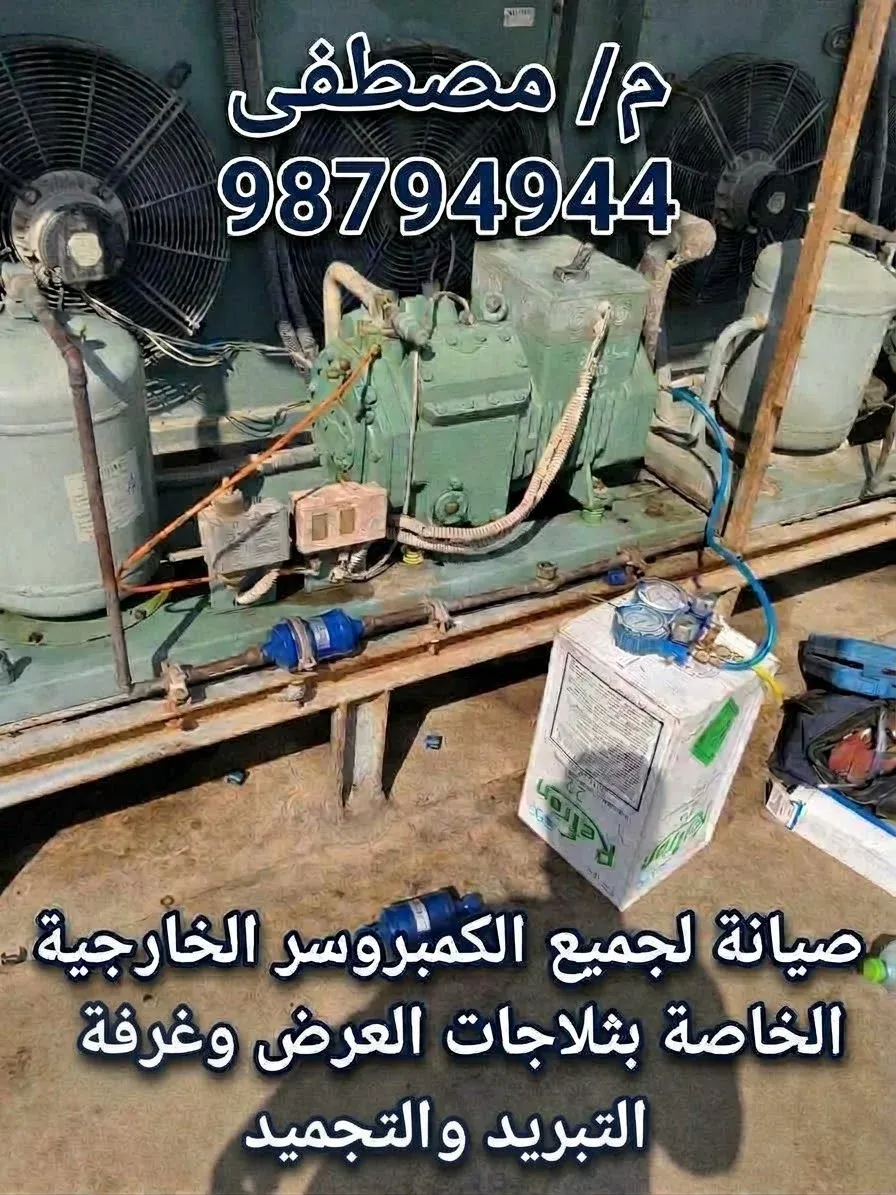
Restarting a cold room after relocation involves much more than switching on the circuit breaker and waiting for the compressor to start.
New piping or modified connections may have been installed during relocation, and the positions of the condenser and evaporator or the dimensions of the cold room may have changed.
The enclosure, electrical system, refrigeration circuit, and controls must therefore be checked before the room is used to store food or other temperature-sensitive products.
Can the Cold Room Be Switched On Immediately After Panel Installation?
Not necessarily.
Electrical or mechanical work may still be incomplete, or the refrigeration circuit may need testing after reconnection.
Panel and door sealing must also be reviewed.
Equipment must not be started until the components are ready according to the system design.
Is Refrigeration Pipe Leak Testing Necessary After Relocation?
If the circuit has been opened or connections have been reinstalled, checking leak-tightness using the procedures appropriate for the equipment is important.
The method and testing limits may vary according to the system type.
Even components that were not opened may require inspection if there are signs of damage during handling.
Danfoss guidance explains that leak testing and evacuation are part of preparing condensing units for applications requiring these procedures.
Is Vacuum Evacuation Required After Reinstallation?
Evacuation using suitable equipment may be necessary when parts of the circuit have been exposed to air or moisture during disconnection and reconnection.
However, the exact scope depends on the system design and work performed.
The compressor itself must not be used as a substitute for a vacuum pump.
Manufacturer instructions must be followed.
Must the Refrigerant Be Replaced After Moving the Cold Room?
Not necessarily in every case.
The decision depends on how the circuit was disconnected, the refrigerant's condition, manufacturer requirements, and the work carried out.
The refrigerant may be recovered and handled according to appropriate procedures, while other situations may require a new charge or a different treatment.
Refrigerants must not be added or mixed arbitrarily simply because they are available.
Will the Previous Thermostat Settings Still Be Suitable?
Some previous settings may remain suitable if operating conditions have not changed, but they must be reviewed after relocation.
The required temperature, sensor locations, or cooling loads may have changed.
Alarms and protective devices must also be checked.
Settings should not be changed randomly in an attempt to make the temperature drop faster.
Must the Door Be Checked After Reinstallation?
Yes. Reinstalling the frame or changes in floor levelness may affect how the door closes.
Hinges and gaskets may also require adjustment or replacement.
The door must be checked for gaps that allow warm air to enter.
In rooms large enough for people to enter, the internal emergency release mechanism must also be tested.
Does the Cold Room Need an Operating Period Before Products Are Loaded?
The room may need time to reach the required temperature and demonstrate stable operation.
The duration depends on its initial temperature, dimensions, refrigeration capacity, and site conditions.
A single fixed time cannot be specified for every room.
Successful testing while the room is empty does not eliminate the need to monitor performance during actual use.
Does Compressor Operation Mean the Relocation Was Successful?
No. The compressor may run while the system still has a problem involving airflow distribution, controls, refrigerant charge, or insulation.
Room temperature must therefore be monitored, and the fans, condenser, and evaporator inspected.
Technical operating readings should also be reviewed as appropriate for the system.
The project is not complete merely because the compressor can be heard running.
What Should Be Tested Before Returning Products to the Cold Room?
|
Test item |
What should be checked? |
Why is it important? |
|
Room panels |
Joint sealing and integrity |
Reduces heat infiltration |
|
Door |
Closure and gaskets |
Maintains cooling conditions |
|
Electricity |
Connections and protection |
Supports safe operation |
|
Refrigeration circuit |
Leak-tightness and required procedures |
Reduces leakage risks |
|
Compressor |
Operating conditions |
Supports system reliability |
|
Condenser |
Ventilation and fans |
Allows effective heat rejection |
|
Evaporator |
Fan operation and airflow |
Supports cooling distribution |
|
Drainage |
Absence of accumulated water |
Supports hygiene and equipment protection |
|
Controls |
Sensors and settings |
Supports operating monitoring |
|
Alarms |
Functionality where installed |
Enables response to faults |
|
Temperature |
Reaching the required level |
Confirms storage readiness |
Should the Cold Room Be Monitored After Handover?
It is advisable to monitor temperatures during initial operation and pay attention to unusual sounds, vibration, or leakage.
The door and newly installed connections should also be monitored.
The technician may need to return if a problem appears after products are loaded.
If you have moved a cold room into a new shop, do not return products until the insulation and refrigeration have been tested and the room has reached the required storage temperature.
Moving a Freezer Room to a New Warehouse: What Must Be Prepared Before Relocation?
When planning to move a freezer room to a new warehouse, it is not enough to confirm that the existing enclosure fits inside the new building.
A freezer room requires a design suitable for its operating temperature, flooring, insulation, product movement, and refrigeration equipment location.
The room may have been suitable for frozen products at the previous premises, but operating requirements may change if inventory quantities increase or doors are opened more frequently.
Relocation should therefore be treated as a new installation project using existing components, rather than merely changing the equipment's address.
Is the New Warehouse Large Enough for the Freezer Room?
The freezer room's external dimensions must be compared with the available space at the new location.
Sufficient clearance must also be provided for panel installation and maintenance access according to the design.
Ceiling height, entrances, and door positions may require further review.
The available space should not be approved from a drawing alone if physical obstacles are present.
Is the New Warehouse Floor Suitable for Freezing Applications?
Requirements depend on the original floor design, operating temperature, and building conditions.
Some applications may need insulation layers, vapor barriers, or other measures to prevent problems associated with low temperatures.
Floor levelness and load-bearing capacity must also be checked.
A freezer room should not be installed on any available floor without appropriate engineering and technical assessment.
Does Relocating a Freezer Room Require the Property Owner's Approval?
The project may require coordination with the property owner or building management, depending on the lease conditions and nature of the work.
This is particularly important if equipment will be mounted on the roof or new openings, electrical modifications, or structural changes are required.
Official permits and approvals relevant to the business and property must also be checked.
Permanent modifications should not begin before the applicable requirements are established.
Is the Condensing Unit Location Suitable at the New Warehouse?
A suitable position must allow efficient heat rejection and provide maintenance access.
The new location may be hotter or less ventilated than the previous one.
Refrigeration piping lengths and vertical differences may also change.
The system's performance under the new conditions must therefore be reviewed, particularly during Kuwait's summer.
Can a Freezer Room Be Moved From a Small Warehouse Into a Larger One?
The components may be relocated, but this does not mean that they are capable of cooling a larger space.
The thermal load may increase as wall surface area, product quantities, or door movement increase.
Airflow distribution may also change.
The new cooling load must therefore be calculated, and the compressor and evaporator assessed before they are reused.
Does the Door Need Replacement if Loading Procedures Change?
A different door or new door position may be required if the warehouse uses larger carts or handling equipment.
However, the change must preserve insulation integrity and safe internal exit arrangements.
A larger opening may also increase the cooling load because more warm air can enter.
The doorway must not be enlarged without reviewing the insulated panels and fastening system.
Do Frozen Products Need a Separate Transportation Plan?
Yes. Frozen inventory requires transportation and storage conditions appropriate for those products.
Refrigerated transportation or alternative frozen storage may be necessary depending on product quantities and the relocation period.
Product safety must also be assessed before and after the move according to food safety procedures.
Products should not be assumed safe merely because they still feel cold to the touch.
Can the Relocation Be Completed in Stages?
This may be possible if the project has multiple cold rooms or independent refrigeration systems.
However, the stages must be arranged so that existing inventory is not affected by equipment that remains in operation.
The point at which the new location becomes ready must also be established.
Preparing the flooring and electrical supply in advance may help reduce operational disruption.
What Is the Preparation Checklist for the New Warehouse?
-
Confirm the business activity and necessary approvals.
-
Measure the available space, doors, and corridors.
-
Check floor levelness and load-bearing capacity.
-
Review floor insulation requirements.
-
Determine the freezer room location.
-
Establish access routes for panels and equipment.
-
Check the electrical supply.
-
Select the condensing unit position.
-
Assess refrigeration piping routes.
-
Determine evaporator locations.
-
Review defrost drainage arrangements.
-
Check door and safe internal exit requirements.
-
Prepare a transportation plan for frozen products.
-
Identify the tests needed before handover.
Is It Better to Move the Old Freezer Room or Install a New One?
That depends on the condition of the panels and equipment, their compatibility with the new warehouse, and the cost of modifications.
Reusing an undamaged room may be economical, while damaged insulation or major design differences may make a new installation more appropriate.
If you want to move a freezer room to a new warehouse in Kuwait, inspect the new premises and calculate its requirements first. Then determine which components from the old room are worth transporting and reusing.
How Long Does It Take to Dismantle and Reinstall a Cold Room? Timing Depends on Size, Location, and Equipment
The question "How long does it take to dismantle and reinstall a cold room?" is important for restaurant and shop owners working toward a new opening date or a property handover deadline.
Refrigeration downtime may affect inventory, customers, and sales.
However, a fixed duration cannot be provided for every project without an inspection. A room may be small with a straightforward assembly system, or it may be large with numerous panels and several refrigeration units.
The new premises may also be ready for installation or require flooring, electrical, lifting, and piping work.
Can a Cold Room Be Dismantled and Reinstalled in One Day?
Some simple projects may be completed within a relatively short period if both sites are ready, all components are in good condition, and no complicated work is necessary.
However, completing every project in one day cannot be guaranteed.
Refrigerant recovery, dismantling, transportation, reassembly, and testing may require separate stages.
Product relocation plans should therefore not depend on an unconfirmed completion promise.
Is Dismantling Time Different From Reinstallation Time?
Yes. Dismantling focuses on disconnecting, protecting, and documenting components, while reinstallation requires aligning and sealing panels and reconnecting equipment.
The new premises may need preparation, or some parts may require replacement.
The system must also be tested before operation.
Reinstallation and recommissioning may therefore take longer than dismantling.
Does Cold Room Size Determine the Duration?
Size affects the number of panels and equipment components and the amount of handling required.
However, accessibility, connection types, and component condition also matter.
A large modular room may be easier to dismantle systematically than a smaller room that has undergone repeated modifications.
The entire project must therefore be assessed.
Does the Type of Sandwich Panel Affect the Time Required?
Yes. Some systems use modular locking mechanisms, while others require different dismantling procedures.
Certain joints may contain sealing compounds or fasteners that are difficult to remove.
Damaged locks or panels may also require replacement components.
The assembly system should therefore be identified before the work schedule is prepared.
Does Moving the Compressor Add Time?
It may involve additional work to disconnect the circuit, handle refrigerant, secure the unit, transport it, and reconnect it.
Electrical connections and piping may also be different at the new premises.
Suitable tests must be completed before operation.
These stages must not be omitted simply to shorten the project.
Can Flooring Work Delay Installation?
Yes, if the floor is uneven or needs preparation or moisture treatment.
Some finishing materials may also need sufficient time before being subjected to loads.
Where possible, flooring preparation should be completed before the insulated panels arrive.
The floor must also be inspected for suitability before assembly begins.
Does the Distance Between Locations Affect Transportation Time?
It may affect loading, transportation, and unloading time, but it is not the only factor.
Accessing equipment inside the building may be the most difficult part of the operation.
Some loads may also require special arrangements.
The number of journeys and transportation method must therefore be established before the schedule is approved.
Are Tests Included in the Relocation Schedule?
They should be included in the project plan.
Recommissioning requires inspection of leak-tightness, electrical systems, and equipment according to the work performed.
The cold room must also reach its required temperature, and its performance must be monitored.
From the customer's perspective, installation should not be considered complete without clearly defining the testing and handover stages.
Stages of Cold Room Dismantling, Transportation, and Reinstallation
|
Stage |
Work involved |
What may cause delays? |
|
Inspection |
Assessing both locations and equipment |
Missing information or difficult access |
|
Inventory preparation |
Emptying the room and protecting products |
Lack of alternative refrigeration |
|
Technical disconnection |
Electrical and refrigeration systems |
Complex equipment |
|
Enclosure dismantling |
Panels, doors, and flooring |
Connection type and condition |
|
Packaging and loading |
Protecting and arranging components |
Weight and access routes |
|
Transportation |
Moving components between locations |
Multiple journeys or access difficulties |
|
Site preparation |
Flooring, electricity, and supports |
Incomplete work |
|
Reassembly |
Panels and doors |
Damage or dimensional differences |
|
Equipment installation |
Condensing unit, evaporator, and piping |
Piping and electrical modifications |
|
Testing |
Leak-tightness, safety, and operation |
Problems requiring correction |
|
Handover |
Temperature monitoring and documentation |
Unstable performance |
How Can You Reduce Business Downtime?
It is preferable to prepare the new premises before dismantling day, confirming that the electricity, flooring, and equipment access routes are ready.
Products should also be removed and suitable alternative storage arranged.
The original drawings and technical information should be available if possible.
Most importantly, request a written schedule explaining the stages and dependencies before work begins.
If you are asking how long it takes to dismantle and reinstall a cold room in Kuwait, request a schedule based on the actual room and both locations, including testing and recommissioning—not merely a date for dismantling and transportation.
Can Cold Room Panels Be Reused After Relocation? Costs, Service Steps, and Why Contact Us
The question "Can cold room panels be reused after relocation?" often determines whether transporting the existing room is an economical option or whether installing a new cold room at the new location would be preferable.
Direct answer: Some cold room and freezer room panels can be reused if they are undamaged, their assembly system permits dismantling, their dimensions suit the new premises, and proper insulation and joint sealing can be restored.
However, it is not possible to guarantee that every panel can be reused before inspection, particularly when panels are damaged or installed using connections that are difficult to dismantle.
Modular cold room installation manuals explain that panel sealing depends on proper alignment, the condition of assembly locks, and the integrity of gaskets. These elements must therefore be inspected during reinstallation.
What Signs Suggest That Panels Are Suitable for Relocation?
Positive signs include undamaged surfaces and the absence of obvious deformation or serious damage along the edges.
The assembly connections must also be in a condition that allows them to function correctly.
Gaskets and joint areas should be reviewed.
However, external appearance alone is not sufficient to assess the condition of the insulation throughout the panel.
Are Old Cold Room Panels Less Efficient After Relocation?
Not necessarily. Panels may retain suitable performance if they remain undamaged and are handled and reinstalled correctly.
However, physical damage, open joints, or moisture penetration may affect their performance.
The condition of the door, flooring, and other components must also be reviewed.
The age of the room alone should not be treated as a direct measure of its current insulation quality.
Do Reused Panels Require New Materials?
They may require new gaskets, sealing materials, or fasteners, depending on their condition and assembly system.
Certain areas may also require modification or replacement of individual panels.
Materials must be suitable for the operating temperature.
It is therefore preferable for the quotation to include an allowance for potentially necessary consumable materials.
Can Ceiling Panels Be Reused?
That depends on their type, condition, loading arrangements, and the way they were supported and installed in the original design.
The ceiling may require suitable supports or connections at the new location.
Any damage occurring during dismantling and lifting must also be assessed.
Panels must not be walked on or subjected to loads that have not been approved for the system.
Can an Existing Cold Room Be Reassembled With Smaller Dimensions?
Some modular systems may allow panels to be rearranged into a different configuration, but this is not guaranteed.
Certain panels may be designed specifically for corners, doors, or ceilings, and locking mechanisms may not be compatible with the proposed arrangement.
Refrigeration and airflow requirements may also change.
A design showing which panels can be reused must therefore be prepared before any panel is cut.
Is Reusing Existing Panels Cheaper Than Buying a New Cold Room?
It may be less expensive if the panels and refrigeration equipment are in good condition and the new premises are suitable.
However, dismantling, transportation, replacement materials, reinstallation, and testing costs may reduce the difference.
The expected remaining service life of the equipment and any required refurbishment must also be considered.
It is therefore better to compare the total relocation and recommissioning cost with a quotation for a new cold room built to the required specifications.
When Is Installing a New Cold Room the Better Option?
A new installation may be preferable when the existing panels are damaged, the dimensions are unsuitable, or the new location requires a substantially different design.
Existing refrigeration equipment may also be inadequate for the new cooling load.
In these circumstances, technical and financial feasibility should be compared before relocation.
The project should not be continued simply because dismantling has already begun.
How Much Does Cold Room and Freezer Room Relocation Cost in Kuwait?
A reliable fixed price in Kuwaiti dinars cannot be given for every project.
Costs vary according to dimensions, the panel assembly system, equipment condition, transportation distance, and the characteristics of both locations.
Electrical work, refrigeration piping, new materials, and testing also affect the total cost.
The best approach is to request an itemized quotation after inspecting both sites and identifying the components that can be reused.
Comparing Relocation of an Existing Cold Room With Installing a New One
|
Comparison criterion |
Dismantling and relocating the existing room |
Installing a new cold room |
|
Insulated panels |
Reuse undamaged panels |
New panels with the required specifications |
|
Dimensions |
Limited by the configuration of existing components |
Greater design flexibility |
|
Door |
Reused if suitable |
A suitable type and position can be selected |
|
Refrigeration unit |
Existing equipment must be reassessed |
Selected according to the new cooling load |
|
Flooring |
May require new preparation |
Constructed according to the new design |
|
Cost |
Dismantling, transportation, refurbishment, and installation |
Materials, fabrication, and installation |
|
Completion time |
Depends on room condition and preparation of both locations |
Depends on supply and fabrication |
|
Warranty |
Varies between existing components and new work |
According to equipment and installation terms |
|
Economic suitability |
Depends on existing component condition |
Depends on project requirements and budget |
What Related Services Are Advertised by Cold Room and Display Refrigerator Maintenance?
The Cold Room and Display Refrigerator Maintenance website describes installation and maintenance services for cold rooms, freezer rooms, and display refrigerators, along with work involving compressors, evaporators, and insulated sandwich panels.
The website also advertises experience in commercial refrigeration in Kuwait and services for establishments such as supermarkets and cooperative societies.
However, the information available for verification does not confirm a specifically advertised package for dismantling and relocating cold rooms between commercial premises, or a fixed price for that service.
It is therefore important to inquire directly about the availability and scope of dismantling, transportation, and reinstallation before booking.
Why Choose a Provider That Inspects the Cold Room Before Relocation?
When comparing service providers, it is important to assess whether they can explain the room's condition, relocation risks, and required work.
Useful criteria include:
-
Inspecting the old and new locations.
-
Explaining the condition of panels and connections.
-
Identifying reusable components.
-
Reviewing compressor and evaporator condition.
-
Preparing a plan for refrigerant handling.
-
Explaining electrical disconnection procedures.
-
Labeling panels and components.
-
Using suitable packaging and loading methods.
-
Assessing new flooring and dimensions.
-
Calculating any necessary piping modifications.
-
Performing suitable tests after reinstallation.
-
Monitoring performance before handover.
-
Providing a clear invoice.
-
Explaining warranty coverage for newly completed work.
These are standards that should be confirmed in the quotation, not automatic guarantees or claims that every company provides all these services.
What Information Is Required When Requesting a Quotation?
To obtain a clearer assessment, prepare the following information:
-
Name of the shop, restaurant, or warehouse.
-
Governorate and district of the existing location.
-
Governorate and district of the new location.
-
Room type: chilled cold room or freezer room.
-
Room length, width, and height.
-
Approximate age of the cold room.
-
Type of insulated panels, if known.
-
Condition of the door and flooring.
-
Number of condensing units and evaporators.
-
Equipment location: ground level, rooftop, or equipment room.
-
Whether the room has undergone previous repairs.
-
Whether it currently maintains the required temperature.
-
Available drawings or photographs of the room.
-
Floor levels and access routes.
-
Readiness of the electrical supply and flooring at the new premises.
-
Deadline for vacating the old premises.
-
Planned opening date of the new premises.
-
Whether you require transportation only or relocation and recommissioning.
How Can You Inquire About Cold Room or Freezer Room Relocation in Kuwait?
Contact Cold Room and Display Refrigerator Maintenance through the official website and explain that you want to dismantle an existing cold room and move it to a new shop or warehouse.
Send the room dimensions, existing and new locations, and safe photographs of the equipment.
Then ask whether the provider offers relocation services and whether both locations can be inspected to prepare a quotation covering dismantling, loading, transportation, installation, and testing.
You can also request a technical comparison between reusing the existing room and installing a new one if the panels or refrigeration equipment are old.
If you want to relocate a cold room or freezer room, begin by checking whether the panels and equipment are suitable for reuse. This helps you decide whether relocation is worth the cost before dismantling begins.
Frequently Asked Questions About Cold Room and Freezer Relocation in Kuwait
How Much Does It Cost to Move a Cold Room From One Shop to Another in Kuwait?
The cost depends on the room dimensions, number of panels, equipment condition, distance between locations, and difficulty of loading and lifting.
The costs of disconnecting, transporting, reinstalling, and testing the condensing unit, evaporator, piping, and electrical connections also affect the total.
There is no fixed price for every project.
It is preferable to request a quotation covering the entire process from dismantling through recommissioning.
How Long Does It Take to Dismantle and Reinstall a Cold Room?
The duration depends on the room's size, panel assembly method, component condition, and readiness of the new premises.
Some straightforward projects may be faster than others, while larger rooms or work involving piping and electrical modifications may require additional time.
Operational testing and reaching the required temperature must be included in the project schedule rather than calculating transportation time alone.
Can Sandwich Panels Be Reused After Dismantling a Cold Room?
Yes. Some panels can be reused if they are undamaged, their connections allow dismantling and reassembly, and their dimensions are suitable for the new location.
However, gaskets, fasteners, or individual panels may need replacement.
Insulation and joint sealing must also be checked before reuse is approved.
Does Moving a Freezer Room Require a New Refrigerant Charge?
That depends on the refrigeration system design, how its components are disconnected, and the work required.
The process may involve recovering and handling refrigerant according to appropriate procedures, followed by testing, circuit preparation, and recharging when necessary.
The refrigerant quantity must not be determined, and the refrigerant type must not be changed, without checking the equipment specifications.
Is It Better to Move My Existing Cold Room or Buy a New One?
The decision depends on the condition of the panels, compressor, evaporator, door, and flooring, and whether these components are compatible with the new location and its cooling load.
If the components are undamaged and suitable, relocation may be an economical option.
However, if there is substantial damage or the new premises require extensive modifications, installing a new cold room may be more appropriate.
It is better to compare the complete cost and expected remaining service life of both options.
Conclusion: Cold Room and Freezer Relocation in Kuwait Starts With Inspecting Both Locations Before Confirming Cost and Timing
If you are planning to move your restaurant, grocery store, or food warehouse to a new location, cold room and freezer dismantling and relocation in Kuwait requires a clear technical plan.
The objective is to preserve as many usable components as possible while avoiding damage to insulated panels, refrigeration equipment, or delays to the opening of your new business premises.
The process is not limited to removing and loading sandwich panels.
It also involves assessing insulation, doors, flooring, the compressor, evaporator, piping, electrical connections, and controls, while determining whether these components are suitable for the new location.
Throughout this guide, we have explained the factors that determine the cost of moving a cold room from one shop to another, the differences between dismantling chilled and frozen storage rooms, and the importance of safely handling the condensing unit and refrigerant.
We have also explained that modular cold room panels may be reusable when they are in good condition, but the suitability of every panel or gasket cannot be guaranteed without an inspection.
We have covered the relocation stages, from inspecting both sites, removing stored products, disconnecting equipment, and labeling components to reinstallation, leak-tightness testing, and recommissioning.
As for the time required to dismantle and reinstall a cold room, it varies according to project size, component condition, and the readiness of the new premises.
You should therefore request a schedule covering every stage, including performance testing before products are returned to storage.
It is also important that saving the cost of a new cold room is not the only objective.
Reusing equipment that is unsuitable for the new space may cause refrigeration and operating problems later.
The better approach is to compare the cost of relocation and refurbishment with installing a new room designed for the required dimensions and refrigeration capacity, particularly if the existing room has suffered damage or undergone repeated repairs.
Are You Moving Your Shop, Restaurant, or Warehouse in Kuwait and Want to Know Whether Your Existing Cold Room Is Suitable for the New Premises?
Contact Cold Room and Display Refrigerator Maintenance through the official website.
Send the cold room dimensions, photographs of the panels and equipment, and the locations of the old and new premises.
Then inquire about the availability of dismantling, transportation, and reinstallation services and whether a technical assessment and comprehensive quotation can be provided.
Before dismantling and relocating a cold room or freezer room in Kuwait, verify the condition of the components and the readiness of the new location. Calculate the relocation cost, required time, and recommissioning tests before making a decision.
A carefully planned relocation can help protect your equipment and organize your business move with as little disruption as reasonably possible, without relying on promises that cannot be guaranteed.