Central Refrigeration Compressor Rack Repair in Kuwait
·
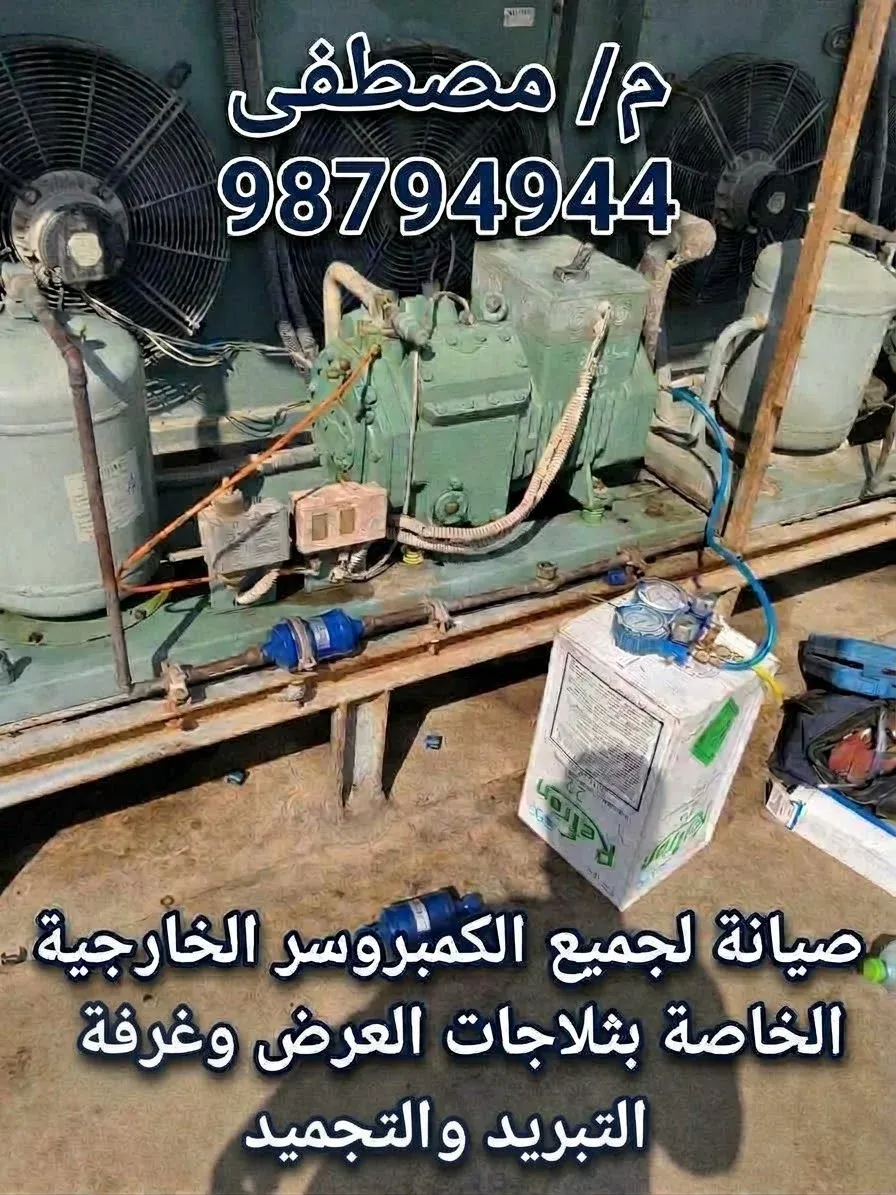
Multi-Compressor Rack Repair in Central Refrigeration Systems
If you operate a supermarket, cooperative society, or food factory in Kuwait and notice that display refrigerator temperatures have increased, one of the compressors has stopped operating, or repeated pressure alarms appear on the control panel, the problem may involve the compressor rack system supplying several refrigeration circuits or groups of refrigerated equipment.
In such situations, you need central refrigeration compressor rack repair that considers the operation of the entire compressor group rather than simply replacing the compressor that has stopped.
Direct answer: Compressor rack repair begins with checking suction and discharge pressures, compressor conditions, the oil distribution system, pressure sensors, the condenser, the control panel, and compressor operating sequences. Repair costs vary according to the cause of the fault, the number of affected components, the replacement parts required, and the complexity of the system.
The inspection is especially important because one compressor may stop due to an electrical problem, low oil level, or activation of a protective device rather than because the compressor itself is damaged.
Likewise, the fact that the remaining compressors continue operating does not guarantee that the group can maintain the required temperatures in all the connected refrigerators and cold rooms.
In this guide from Cold Room and Display Refrigerator Maintenance, we explain the most important compressor rack faults, the differences between pressure, oil, and control problems, how parallel compressor systems are maintained, and which factors determine repair costs before approving the replacement of compressors or control components.
Central Refrigeration Compressor Rack Repair: What Does Inspection and Repair Include?
Central refrigeration compressor rack repair requires an understanding of how several compressors operate together because a rack usually consists of two or more compressors connected within a shared refrigeration system and operated according to the required load and the system's control strategy.
A compressor rack may supply several display refrigerators, cold rooms, or product storage units. As a result, a single fault can affect more than one area within a facility.
It is not sufficient to diagnose each compressor separately because shared components may be responsible for the problem.
What Is a Compressor Rack?
A compressor rack is an arrangement containing several compressors operating in parallel within a refrigeration system designed to handle multiple loads.
In conventional parallel systems, the compressors may share suction and discharge headers, an oil management system, and certain condensing and control components.
Technical references from the American Society of Heating, Refrigerating and Air-Conditioning Engineers explain that these systems are used in supermarket applications and may contain compressors with equal or different capacities to improve the match between available refrigeration capacity and changing loads.
However, connection arrangements vary according to refrigerant type and system design, including modern refrigeration systems that use different operating configurations.
Why Are Several Compressors Used in Central Refrigeration?
Refrigeration loads in supermarkets and factories change throughout the day depending on the number of refrigerated cabinets operating, door-opening frequency, inventory quantities, and weather conditions.
Using several compressors allows the system to operate at a capacity that corresponds to demand according to its control strategy.
A larger number of compressors may operate during periods of high load, while fewer compressors may be required when demand decreases, depending on the design.
However, operating methods differ between systems. Variable-speed compressors and other capacity control methods may also be used.
Which Components Are Included in a Compressor Rack Inspection?
A technical inspection may include:
The compressors and the operating condition of each unit.
The suction header and discharge header.
Pressure sensors and pressure transducers.
High-pressure and low-pressure protective devices.
The condenser, its fans, and condensing pressure controls.
The oil separator, oil reservoir, and oil level regulators.
Isolation valves, control valves, and piping components.
The electrical control panel, contactors, and protective devices.
The rack controller and compressor operating sequence.
Alarm records and compressor operating hours.
Refrigerant condition and possible leakage indicators.
The performance of connected display refrigerators and cold rooms.
This does not mean that every system contains these components in exactly the same configuration. The actual compressor rack diagram must therefore be reviewed before the appropriate tests are selected.
Does One Compressor Stopping Mean the Entire Rack Will Stop?
Not necessarily. Other compressors may continue operating if the design allows it and the protective devices and operating conditions remain satisfactory.
However, the remaining capacity may not be sufficient to cover the required refrigeration load, particularly during peak demand or hot summer conditions.
In other cases, a shared pressure, oil, or control problem may cause several compressors to stop.
The system's performance and the condition of the facility's inventory must therefore be assessed together rather than relying only on the number of compressors still running.
What Warning Signs Indicate That a Compressor Rack Needs Inspection?
Important warning signs include:
Rising temperatures in several display refrigerators at the same time.
Repeated suction or discharge pressure alarms.
A compressor that fails to operate despite an active refrigeration demand.
Unusual differences in compressor operating hours.
Repeated oil level alarms.
Unusual noises or vibrations from one compressor.
High discharge temperatures or associated alarms.
Protective devices repeatedly shutting down equipment.
Continued rack operation without achieving the required refrigeration temperatures.
Communication or control errors appearing on the rack control panel.
These symptoms must be interpreted using the system's operating data. They are not conclusive proof that a particular component is defective.
What Should You Do First if Supermarket Refrigerator Temperatures Rise?
Record the temperature readings, alarm times, and affected departments. Reduce activities that increase the refrigeration load where possible.
If temperature-sensitive food products are present, check their actual temperatures and the duration of exposure to unsuitable conditions, then follow the facility's procedures for protecting inventory.
Do not disable protective devices or force stopped compressors to operate manually.
Electrical panels and refrigerant connections must not be opened by unqualified personnel.
Can the Compressor Rack Be Repaired Without Shutting Down All Refrigerators?
That depends on the system's design, the type of fault, and the isolation arrangements available.
Some inspection procedures may be possible while parts of the system remain in operation, whereas other work requires a compressor, circuit, or entire rack to be isolated using approved safety procedures.
Continued operation of every refrigerator during repairs cannot be guaranteed before reviewing the system diagram and equipment condition.
If a compressor rack is causing weak refrigeration in several departments, contact Cold Room and Display Refrigerator Maintenance to inquire about inspecting the system and determining the required repair work before replacing compressors.
Compressor Rack Maintenance in Kuwait: How Are Recurring Operating Faults Managed?
Compressor rack maintenance in Kuwait requires regular monitoring of system performance, particularly in facilities where display refrigerators and cold rooms operate for extended periods.
The rack may experience changing loads throughout the day, while the temperature surrounding the condenser and the movement of stored goods also affect operating conditions.
Proper maintenance involves more than cleaning the equipment. It also includes reviewing controls, pressures, oil management, protective devices, and fault records.
Why Do Compressor Rack Problems Recur During Hot Weather?
High outdoor temperatures may affect the condenser's ability to reject heat, especially if it is dirty or the fans or ventilation arrangements are inadequate.
This may create more demanding operating conditions for certain components.
However, repeated summer breakdowns do not automatically mean that the compressor rack's design is unsuitable.
Actual operating conditions, condenser specifications, and control arrangements must be reviewed before reaching that conclusion.
Is Condenser Cleaning Enough to Maintain a Compressor Rack?
No. Condenser cleaning is important when dirt accumulates, but it is only one part of maintenance.
Problems may also involve oil levels, pressure devices, electrical circuits, or the distribution of loads between compressors.
Refrigerant leakage and the performance of the condenser and fans may also need attention.
Maintenance should therefore follow an inspection checklist appropriate for the rack's design rather than repeatedly performing one procedure regardless of the fault.
What Does Frequent Compressor Starting and Stopping Mean?
A facility owner may notice that one compressor starts, stops after a short period, and then repeatedly cycles in the same way.
This pattern may be associated with control settings, changing loads, protective device problems, or pressure conditions.
Technical references on supermarket refrigeration system design emphasize the importance of suitable capacity and pressure control to avoid undesirable short operating cycles.
However, normal operating durations vary between systems, so the number of starts alone cannot establish the cause of a fault.
Are Unequal Compressor Operating Hours Evidence of a Fault?
Not necessarily. The rack controller may use a strategy that rotates starting priority or distributes loads according to compressor capacity.
One compressor may also have variable capacity control or be assigned a particular operating function.
However, unexplained differences in operating hours or repeated shutdowns affecting a particular compressor may require investigation.
Operating records must therefore be compared with the original control strategy rather than assuming that every compressor should operate for the same number of hours.
Why Is It Important to Record Alarms Before Clearing Them?
Alarm records may show whether a compressor stopped because of high pressure, low pressure, an oil level problem, an electrical fault, or a communication problem.
Clearing these messages before documenting them may remove important information that helps establish the sequence of events leading to the fault.
It is preferable to photograph the controller screen or export the event log using the functions available on the device.
However, an alarm code should not be treated as a final diagnosis without investigating its cause.
Can Compressor Rack Maintenance Be Performed During Supermarket Opening Hours?
Some systems may allow limited inspections and maintenance tasks while operating, but this depends on the type of work and its associated risks.
Electrical or mechanical procedures requiring isolation must not be performed unsafely simply to avoid shutting down refrigerators.
It is better to agree in advance on a work plan, inventory protection arrangements, and the times when affected equipment will need to be isolated.
What Does a Preventive Maintenance Plan Include?
Depending on the system specifications, a preventive maintenance program may include:
Reviewing suction and discharge pressure readings and trends.
Inspecting condenser operation and condenser fans.
Reviewing compressor operating sequences and running hours.
Inspecting protective devices and alarms.
Checking oil levels and the oil distribution system.
Looking for evidence of leaks and unusual vibrations.
Checking equipment cleanliness and ventilation.
Having electrical connections inspected by a qualified specialist.
Checking sensors and control readings.
Documenting observations, repairs, and follow-up recommendations.
These procedures may help identify certain problems early, but they cannot guarantee that every breakdown will be prevented.
Is a Maintenance Contract Suitable for a Commercial Compressor Rack?
A maintenance contract may be appropriate for facilities that depend on a central refrigeration system supplying many refrigerators and cold rooms.
However, the agreement should specify the number of visits, inspection scope, repair labor charges, replacement parts, and procedures for handling emergency faults.
It must also clarify whether monitoring and alarm follow-up are included or provided as separate services.
Comparing the actual contractual terms is preferable to relying on general descriptions such as "comprehensive maintenance."
Multi-Compressor Technician for Supermarkets: How Is Weak Refrigeration Diagnosed?

When requesting a multi-compressor refrigeration technician for a supermarket, the inspection should cover the relationship between the compressor rack and the connected display refrigerators and cold rooms.
If only one display refrigerator becomes too warm, the problem may involve its evaporator, expansion valve, or local control system.
However, if several refrigerators connected to the same suction group are affected, examining the shared components becomes more important.
Not every case of weak refrigeration inside a supermarket should therefore be attributed automatically to the compressor rack.
What Is the Difference Between a Fault in One Refrigerator and a Compressor Rack Fault?
If only one display refrigerator is affected while the others maintain their required temperatures, the problem may be local to that refrigerator.
Possible causes include a fan, evaporator, control, or refrigerant flow problem.
If several refrigerators experience temperature increases around the same time, a shared cause becomes more likely, making it important to inspect suction pressure, capacity control, and the condenser.
However, the circuit arrangement must be understood because refrigerators located next to one another are not necessarily connected to the same compressor group.
Are All Supermarket Refrigerators Connected to One Compressor Rack?
Not always. A supermarket may use more than one compressor group depending on operating temperatures and the types of refrigeration loads.
One group may serve medium-temperature refrigeration applications, while another handles freezing, or the equipment may be arranged differently according to the design.
ASHRAE technical references explain that supermarket systems may use parallel compressor groups to supply display refrigerators and cold rooms, with applications separated according to their temperature requirements.
The compressor rack supplying the affected equipment must therefore be identified before repairs begin.
Why Is It Important to Know Which Refrigerators Are Connected to Each Group?
This information helps establish the scope of the fault, particularly when alarms or temperature increases appear in several departments.
A number of display refrigerators may share one suction header, while other equipment operates on a different system.
Understanding these connections also helps identify which products may be affected if the compressor rack needs to be shut down during repairs.
A diagram showing how the refrigeration circuits connect to the main compressor groups can therefore be valuable.
Is Weak Cooling in Meat Display Refrigerators the Same as Weak Cooling in Dairy Refrigerators?
Temperature requirements, evaporator designs, and control arrangements may differ according to refrigerator type and the products being stored.
One operating temperature should therefore not be applied automatically to every refrigerator, and alarms should not all be interpreted in the same way.
The problem may involve the settings of a particular display refrigerator rather than the compressor rack's capacity.
A proper inspection considers both the shared compressor group conditions and the requirements of each connected appliance.
How Does a Technician Inspect the Problem During Busy Store Hours?
The technician begins by identifying the affected refrigerators, temperature readings, and alarm records while considering customer movement, doors, and product loading.
The compressor rack's performance, controls, pressures, and the components connected to the affected departments are then reviewed.
Inspection may need to be coordinated with supermarket management to protect food products and keep customers away from maintenance areas.
Exposed electrical or refrigerant piping work should not be carried out in areas accessible to customers without suitable protective measures.
Can Products Be Moved to Other Refrigerators?
This may be appropriate if the alternative refrigerators provide the required storage conditions and have sufficient capacity.
However, products already exposed to unsuitable temperatures must be assessed according to the duration of exposure, recorded temperatures, and storage requirements.
Products should not automatically be considered suitable for sale simply because they have been transferred to a colder refrigerator.
The transfer must also not overload the alternative refrigeration equipment.
What Is the Role of the Central Controller in Diagnosis?
The controller may allow a technician to review compressor operating conditions, pressure alarms, temperatures, and certain performance data.
However, the available functions vary according to the manufacturer, controller model, and connected equipment.
Separate monitoring systems may also record information from the refrigerators and the compressor rack.
It is therefore important to establish exactly which information the system records before relying on it for diagnosis.
When Should the Display Refrigerator Be Repaired Instead of the Compressor Rack?
If measurements show that the central refrigeration group's operating conditions are satisfactory while one refrigerator has a local problem, the required repair may be within that appliance's circuit.
However, this conclusion must be based on inspection results rather than the appliance's location or one temperature reading.
It is also important to confirm that the local fault is not affecting shared components.
If several supermarket display refrigerators are not cooling properly, request an inspection to determine whether the cause is in the shared compressor rack or the individual display refrigeration circuits, so you do not pay for repairs to the wrong equipment.
Central Refrigeration Compressor Group Repair: Does the Entire Group Need Replacement?
Repairing a central refrigeration compressor group differs from repairing a standalone compressor because faults may affect several components and involve shared protective devices, oil systems, and controls.
However, this does not mean that failure of one compressor requires replacing every compressor or the entire rack.
The repair may be limited to one component, while other cases require the underlying shared problem to be corrected before the system can be restarted.
When Does a Compressor Group Need a Comprehensive Inspection?
A comprehensive inspection becomes particularly important when more than one compressor repeatedly shuts down, shared alarms appear, or the system's refrigeration capacity remains inadequate.
The group should also be reviewed if one compressor experiences an internal failure that may be associated with unsuitable oil or pressure conditions.
In these situations, simply installing a replacement part without investigating the cause is insufficient.
The objective is to determine whether the problem is limited to one component or originates from a shared part of the system.
Can One Burned-Out Compressor Affect the Others?
That depends on the type of failure, refrigeration circuit design, and extent to which components are shared.
Certain internal electrical burnout failures may introduce contaminants into the circuit, requiring appropriate inspection and treatment.
However, it cannot automatically be assumed that the remaining compressors have also been damaged.
The circuit, oil, filters, and related components must be evaluated before deciding how much repair work is necessary.
What Is the Relationship Between the Oil Separator and the Compressors?
In some compressor rack systems, the oil separator helps separate oil carried by the refrigerant and return it to the oil management system.
The system may also include an oil reservoir and regulators that distribute oil according to compressor requirements.
Copeland explains that parallel scroll compressor applications require an appropriate oil management arrangement to monitor oil levels and provide protection when they become too low.
However, the technical arrangements vary between scroll, reciprocating, and other compressor types, so the actual system diagram must be reviewed.
Can One Compressor Be Replaced Within the Group?
That may be possible if the compressor is confirmed to be damaged and the refrigeration system is designed to allow its replacement with a compatible unit.
However, the substitute must be checked for capacity, operating range, oil requirements, electrical specifications, and control compatibility.
The procedures for isolating the compressor and recovering refrigerant must also be reviewed according to the design.
A compressor rack should not be treated as a collection of completely independent compressors without considering its shared connections.
Must the New Compressor Have the Same Capacity?
The important requirement is that the replacement is compatible with the system design and its capacity control and pressure requirements.
Some systems intentionally use compressors with different capacities, while others use compressors with equal capacities.
A replacement cannot therefore be selected solely according to its horsepower rating.
Performance data, operating conditions, and the load management strategy must be reviewed before approving a substitute.
What Is the Difference Between Repairing the Group and Replacing the Rack?
Repairing the group may involve replacing damaged components or addressing problems with oil management, pressure, or controls.
Replacing the compressor rack is a more extensive project that may involve the compressor group, shared equipment, piping, and controls according to the system design.
Complete replacement may become an option if the equipment has deteriorated significantly or major repairs are no longer financially reasonable.
However, the decision should not be based solely on the rack's age. Repair and replacement costs, component condition, and spare part availability must also be compared.
Does Replacing the Rack Guarantee That the Problems Will Disappear?
No. If the causes originate outside the compressor group, such as an inadequate condenser, refrigerant flow problems, or loads exceeding the system's design, the problems may continue after replacement.
The complete refrigeration system must therefore be assessed before approving an expensive replacement.
The new rack must also be compatible with the existing evaporators, circuits, and facility requirements.
What Should You Request in the Repair Report?
The report should preferably identify the affected compressors, confirmed faults, shared components inspected, proposed repairs, and tests required after the work.
It should also explain whether additional work may be necessary depending on further inspection results.
Retaining the report can help when comparing findings with any future problems.
Before agreeing to replace an entire compressor group, request a technical explanation of why repairing the damaged component alone would not be sufficient.
Cooperative Society Compressor Rack Repair: How Can Refrigerated Departments Be Protected?
Compressor rack repair for cooperative societies requires careful coordination with facility management because the rack may supply multiple departments, including dairy, meat, frozen food, and some storage rooms.
If part of the system stops working, product temperatures may be affected in several locations even though certain refrigerators continue operating.
Protecting inventory and planning repairs must therefore be organized together.
What Is the First Step if the Compressor Rack Shuts Down in a Cooperative Society?
Begin by identifying the affected departments and recording alarms, temperature readings, and when the problem appeared.
Then take the appropriate measures to protect products according to their storage requirements and the facility's emergency procedures.
Do not attempt to force stopped compressors to operate or bypass protective devices to restore refrigeration quickly.
The shutdown may have occurred because of a condition that must be corrected before restarting is permitted.
Does One Department Failing Mean the Entire Rack Has a Problem?
Not necessarily. A particular refrigerator or local circuit may have failed while the compressor rack itself continues operating appropriately.
On the other hand, a problem with the shared compressor group may affect several departments.
The connections between departments and rack circuits must therefore be understood before establishing the repair scope.
A refrigeration distribution diagram may help reduce the time needed to identify the affected section.
How Can Meat, Dairy, and Frozen Products Be Protected?
The storage requirements for each product category must be followed, including assessment of actual product temperatures and the time spent under unsuitable conditions.
Certain products may need to be transferred to alternative equipment if that equipment is appropriate and has adequate capacity.
However, cooling products afterward does not automatically make previously affected food safe.
Decisions about repairing equipment and decisions about the safety of food offered for sale must therefore be handled separately.
Is It Better to Shut Down All Display Refrigerators During Repairs?
That depends on the system design and the required scope of work.
Some systems may allow a particular section to be isolated, while other repairs require a complete compressor group or shared components to be shut down.
It is not appropriate to promise that every department can continue operating before reviewing the system diagram and the available isolation and protective arrangements.
The technician should explain the repair plan and its expected effects on equipment connected to the compressor rack.
What Is the Role of the Cooperative Society's Operating Staff?
Operating staff can assist by documenting alarms, the timing of temperature increases, and affected departments.
They can also organize inventory transfers and keep customers away from maintenance areas according to management instructions.
However, unqualified employees should not be assigned to open control panels, operate pressure valves, or handle electrical connections.
Every task must remain within the appropriate training and authorization limits.
Do Repeated Summer Breakdowns Mean the Rack Is Undersized?
High outdoor temperatures may increase the demands placed on the condensing system, but this does not establish that the compressor rack's capacity is insufficient without calculations and measurements.
The problem may instead involve the condenser, fans, controls, or equipment cleanliness.
Loads may also have changed because additional refrigerators were connected to the system.
Available capacity and actual refrigeration demand must therefore be reviewed before proposing additional compressors.
Does a Cooperative Society Need a Refrigeration Emergency Plan?
A plan can be useful for identifying who receives alarms, how temperatures are checked, and when products should be removed from sale or transferred according to food safety procedures.
It should also identify available alternative equipment and who is responsible for contacting maintenance personnel.
Such a plan does not mean that every breakdown can be managed without losses, but it can help organize the response.
What Makes a Maintenance Report Useful to Management?
A useful report explains the cause of the fault, the compressor rack components inspected, repairs performed, and any observations that could affect future operation.
Recording repeated alarms and compressors requiring further attention is also valuable.
These records may support future maintenance planning or an assessment of whether repairing older components remains economical.
If several departments within a cooperative society experience rising temperatures, request an inspection that establishes the relationship between compressor rack faults and the affected areas, while prioritizing product protection before repairs begin.
Compressor Rack Pressure Fault Diagnosis: What Causes High Discharge and Low Suction Pressure?
Diagnosing compressor rack pressure faults is one of the most important stages of troubleshooting because changes in operating pressures may indicate problems involving the condenser, refrigeration loads, evaporator supply, controls, or refrigerant charge.
However, pressure readings cannot be interpreted independently of refrigerant type, temperature, operating conditions, and system design.
A compressor rack should therefore not be diagnosed as having insufficient refrigerant or a damaged compressor based on a single pressure reading.
What Are Suction Pressure and Discharge Pressure?
Suction pressure is associated with the low-pressure side through which refrigerant returns to the compressors, according to the circuit design.
Discharge pressure is associated with the gas leaving the compressors and moving toward the heat rejection stages.
Evaporator conditions, condenser operation, refrigeration loads, and controls all affect these pressures.
Modern refrigeration systems may also use different pressure arrangements, so readings must be interpreted according to the actual system diagram.
What Causes High Discharge Pressure?
High discharge pressure may be associated with inadequate heat rejection or a problem with condensing pressure control.
Possible causes include a dirty condenser, insufficient fan performance, inadequate ventilation, or unsuitable operating conditions.
Certain refrigerant charge problems or faults in other components may also contribute, depending on the type of circuit.
However, a single reading is not enough to determine the cause. Temperatures, fan operation, and the system's operating conditions must also be reviewed.
Can Kuwait's Hot Weather Increase Compressor Rack Pressure?
Hot weather may affect condensing conditions, particularly in systems using air-cooled condensers.
However, the system must be evaluated against its design conditions and the equipment's permitted operating limits.
If pressure becomes unusually high or causes a protective device to shut down equipment, the situation should not automatically be considered normal simply because the weather is hot.
The condenser, fans, ventilation, controls, and actual refrigeration load must be reviewed.
What Causes Low Suction Pressure?
Low suction pressure may be associated with reduced refrigeration demand, insufficient refrigerant supply to evaporators, restrictions in refrigerant flow, or control conditions.
An insufficient refrigerant charge may be one possibility, but it is not the only explanation.
Readings may also differ between suction groups according to the system design and the departments connected to each group.
A comprehensive inspection is therefore necessary before deciding to add refrigerant.
Does Low Pressure Mean There Is a Refrigerant Leak?
No. Low pressure may result from other causes requiring diagnosis.
However, if the system has genuinely lost refrigerant, the source of leakage must be identified and repaired.
Repeated recharging should not be used as a substitute for leak detection and repair.
The refrigerant type and the requirements for safely handling it must also be confirmed before technical work begins.
What Are the Risks of Bypassing a Pressure Safety Switch?
Pressure protective devices help prevent equipment from operating outside certain conditions that may be unsafe.
Bypassing them may allow operation to continue even though the underlying fault has not been corrected.
These devices must not be wired in a way that defeats their protective function or repeatedly reset without identifying why they operated.
Tests involving protective circuits must only be performed by qualified specialists using safe and approved procedures.
Can a Pressure Sensor Give an Incorrect Reading?
Yes. Incorrect readings may result from a defective sensor, signal problem, electrical connection, or controller fault.
However, the data must be compared using suitable measuring equipment and procedures appropriate for the system.
The sensor should not be replaced simply because a reading appears unusual.
The actual pressure may genuinely be outside the expected range because of another problem.
How Is Compressor Rack Pressure Diagnosed Properly?
Diagnosis may involve reviewing:
Refrigerant type and compressor rack design.
Suction and discharge pressures under known operating conditions.
The condition of refrigeration loads connected to the group.
Condenser and condenser fan performance.
Compressor operation and starting sequence.
Pressure sensor readings and accuracy.
Protective devices and alarm history.
Indicators of refrigerant flow conditions.
Evaporator condition and refrigerant supply circuits.
Recent changes to equipment or control settings.
The findings determine which additional tests are required. Major components should not be replaced before the underlying problem is understood.
When Does a Pressure Fault Become an Emergency?
The need for prompt intervention increases when the fault causes repeated compressor shutdowns, product temperature increases, or signs of unsafe operating conditions.
However, the system should not be forced to operate despite repeated alarms simply to maintain refrigeration.
Inventory must be protected according to the actual conditions until the problem has been assessed and repaired.
If your compressor rack displays repeated pressure alarms, request an assessment of operating conditions, the condenser, and sensors before agreeing to compressor replacement or refrigerant recharging.
Parallel Refrigeration Compressor Maintenance: How Are Oil and Loads Distributed?
Maintenance of parallel refrigeration compressor systems requires particular attention to oil and load distribution because these systems depend on several compressors operating within a shared arrangement.
A problem with an oil management component or capacity control system may cause repeated shutdowns of a particular compressor or changes in the performance of the group.
However, not all compressor rack systems can be maintained in the same way. Their components vary according to compressor design, refrigerant type, and circuit arrangement.
What Does Load Distribution Between Compressors Mean?
It refers to operating the required capacity from the compressor group in response to refrigeration demand, according to the system's designed control strategy.
This may involve starting additional compressors, stopping some of them, or adjusting the capacity of a particular compressor if its equipment supports that function.
ASHRAE technical references explain that supermarket refrigeration systems use different capacity control arrangements, including multiple compressor staging and variable control of certain components.
However, these functions differ between models, so the actual control program must be reviewed.
Must All Compressors Operate for the Same Number of Hours?
Not necessarily. Some groups use compressors with unequal capacities or follow specific strategies for distributing operating hours.
The controller may also use functions that rotate starting priority or manage refrigeration demand.
Different running hours therefore do not automatically indicate a fault.
However, if one compressor repeatedly shuts down or operates outside the expected pattern, its condition should be compared with the system's control logic and alarm records.
What Is the Function of the Oil Separator in a Compressor Rack?
The oil separator may help remove some of the oil carried in the discharge gas and return it to the oil management arrangement.
In certain systems, oil moves to a shared reservoir and is then distributed to compressors using a suitable control system.
However, oil management design varies according to compressor type and compressor rack components.
The technical diagram must therefore be reviewed before working on the separator, reservoir, or oil level regulators.
Can Low Oil Level Cause a Compressor to Shut Down?
Low oil level may activate protective devices, depending on compressor design and the oil management system.
Copeland explains that scroll compressors used in parallel groups require appropriate oil level monitoring and that a protective system may shut down a compressor if the oil level remains low and is not corrected within the specified period.
However, the type of protection and the oil measurement method differ between compressors.
It should not be assumed that every compressor has an oil pump or uses oil pressure measurements in the same way.
Does Adding Oil to the Rack Correct a Low Oil Level?
Not always. The problem may involve oil distribution, oil return, or an oil management control component.
Certain operating conditions may also affect the movement of oil through the refrigeration circuit.
Adding an unsuitable quantity of oil without diagnosis may create further problems.
Oil levels must therefore be evaluated according to manufacturer instructions and system design before any addition is approved.
Why Does the Oil Alarm Return After the Rack Starts?
This may be associated with changing oil levels during startup or a problem involving the reservoir, separator, level regulators, or oil return conditions.
Copeland's technical guidance explains the importance of monitoring oil levels after starting certain parallel scroll compressor systems because the reservoir level may change until the system reaches stable operating conditions.
However, a recurring alarm does not always mean that an oil level regulator is defective.
The cause of the changes and the related readings must be reviewed before replacing that component.
What Is the Difference Between an Oil Fault and a Pressure Fault?
Either problem may cause a compressor to stop, but the protective device is responding to a different condition.
An oil alarm concerns oil level or lubrication conditions according to the design, while pressure alarms indicate specific conditions in the refrigeration circuit.
The two problems may be related in certain circumstances, but they should not automatically be treated as the same fault.
The complete alarm history and operating data must therefore be examined.
Can Changing the Compressor Starting Sequence Improve Performance?
Some systems include settings for compressor staging, but changes require an understanding of compressor capacities, operating limits, pressure requirements, and protective devices.
An unsuitable adjustment may increase the number of start-stop cycles or place inappropriate loads on a particular compressor.
The control program should therefore not be changed simply to silence an alarm.
The underlying problem must first be corrected, after which the control strategy should be verified against the original system design.
What Should Be Recorded During Maintenance?
It is useful to record oil levels, operating readings, compressor running hours, and recurring alarms.
Any changes to settings or replacement of oil management components should also be documented.
These records may help establish whether a problem is confined to one compressor or related to the operating conditions of the entire group.
If your refrigeration rack repeatedly shuts down because of oil alarms, request an inspection of the complete oil management system rather than simply adding oil or replacing a sensor without determining the cause.
Compressor Rack Control Panel Repair: Resolving Alarms and Operating Errors
When compressor rack control panel repair is needed, it is important to understand that the control panel coordinates compressor operation according to system requirements and signals from sensors and protective devices.
Faults may appear as pressure alarms, a compressor failing to start, or lost communication with a component.
However, an error appearing on the screen does not necessarily mean that the control panel itself is damaged.
The actual problem may involve a sensor, wiring, protective device, or refrigeration operating condition.
What Does the Compressor Rack Controller Do?
Depending on the system design, the controller may monitor suction pressure, regulate compressor capacity, activate alarms, and manage certain condenser functions or related components.
It may also provide event records, operating hours, and data useful for diagnosis.
However, the available functions vary between manufacturers and models.
Not every controller should be assumed to support remote monitoring or record every operating measurement.
Why Does an Alarm Appear While the Compressor Fails to Start?
There may be a demand for refrigeration, but a protective or control condition may prevent the compressor from starting.
This could involve a pressure alarm, an oil problem, electrical protection, or a programmed starting delay.
The starting signal or power circuit may also be faulty.
The reason for the blocked start must therefore be identified before considering contactor or compressor replacement.
Can a Faulty Sensor Stop Several Compressors?
Yes, that may occur if the sensor supplies information used by a shared control function.
However, the effect depends on controller design and how the system is protected.
For example, a problem with a suction pressure reading may change decisions about which compressors should operate, even though the compressors themselves are not damaged.
Sensor signals and controls must therefore be checked before several components are replaced.
What Is the Difference Between a Contactor Fault and a Control Panel Fault?
The controller may issue a correct operating command while the power circuit fails to carry it out because one of its components is defective.
In other cases, no operating command may be issued because of a protective condition or controller problem.
The control circuit and power circuit must therefore be distinguished during diagnosis.
Electrical testing must be performed by qualified personnel using appropriate isolation and safety procedures.
Can Reprogramming the Controller Solve the Problem?
Certain situations may involve unsuitable settings or control data that need to be reviewed.
However, reprogramming is not an automatic solution to every alarm.
Changing pressure values, delay periods, or protective settings may create unsafe operating conditions if the adjustments do not match the design.
Existing settings should therefore be saved and the diagrams and manufacturer instructions reviewed before modifications are made.
Can a Power Outage Cause Control Errors?
Electrical supply problems or disturbances in certain signals may affect control equipment operation.
However, an alarm appearing after electricity is restored does not automatically mean that the controller has been damaged.
The device may be completing a programmed starting delay or may require a review of its recorded status.
If electrical protection repeatedly trips, it must not be bypassed or repeatedly reset without investigating the cause.
Does Replacing the Control Panel Require Reconfiguring the System?
Replacing the controller may require setting up the appropriate functions, connecting inputs and outputs, and verifying protective devices, depending on the model.
Existing settings may also need to be transferred or entered again according to the system documentation.
Installing a panel that looks similar from the outside is not sufficient.
Software compatibility, electrical requirements, and control functions are just as important as connection compatibility.
How Is the Controller Tested After Repair?
The technician reviews readings, alarm conditions, compressor response, and operating sequences under safe conditions.
The protective and control functions associated with the original fault are also checked.
A monitoring period may be necessary to evaluate stable operation.
However, protective devices must not be tested in ways that expose equipment or personnel to danger.
What Should You Ask Before Replacing the Entire Control Panel?
Ask why the panel has been diagnosed as defective and whether the sensors, electrical connections, and protective devices have been checked.
Request the model number of the proposed replacement, confirmation of its compatibility, and clarification of whether configuration and testing are included in the price.
Information about settings and modifications should also be retained where available.
If your compressor rack control panel repeatedly displays alarms, do not agree to replace the entire panel before confirming that the problem is not caused by a sensor, signal, or another protective device.
Repairing a Stopped Compressor in a Rack: Does It Need Replacement or Can It Be Restarted?
Repairing a stopped compressor within a rack system may be necessary when the other compressors continue operating while one remains out of service or a control message prevents it from starting.
However, one compressor stopping does not necessarily mean that its motor has burned out or that it has reached the end of its service life.
The problem may involve a protective device, control system, oil management system, or electrical connection.
The reason for the shutdown must therefore be investigated before compressor replacement is approved.
Why Does One Compressor Shut Down While the Others Continue Operating?
The compressor may have stopped because a protective device specific to that unit was activated while the remaining compressors continued operating within their permitted conditions.
There may also be a problem with its connections or one of its starting components.
The controller may prevent a particular compressor from starting because of load management or a programmed starting delay.
It is therefore important to determine whether the compressor is actually being requested to run before interpreting its stoppage as a fault.
Can a Compressor Stop Because It Is Overheating?
Unsuitable operating conditions may activate thermal protection in certain compressor designs.
However, elevated temperatures may result from condenser problems, excessive loads, suction and discharge conditions, or other components.
The reason for protective shutdown cannot be established simply by observing the compressor shell temperature.
Alarm records and operating data must therefore be reviewed before attempting to restart the compressor.
Can a Compressor That Stopped Because of Low Oil Be Repaired?
That depends on inspection findings and the design of the oil management system.
The compressor itself may be in acceptable condition, while a protective device has stopped it because the oil level is too low.
On the other hand, prolonged operation under unsuitable lubrication conditions may cause internal damage.
The compressor should therefore not be restarted simply because an alarm disappears. The cause of the low oil level must be established and appropriate operating conditions verified.
Can the Compressor Be Started Manually to Check Whether It Works?
The control system and protective devices must not be bypassed to force the compressor to operate.
If the shutdown was caused by high pressure, an oil problem, or electrical protection, forcing a restart could worsen the fault or create a hazard.
Any special operational tests must be performed by qualified personnel in accordance with system instructions and appropriate safety procedures.
What Are the Main Steps in Inspecting a Stopped Compressor?
The inspection may include:
Reviewing the compressor's status on the control panel.
Recording alarms and the reasons for preventing startup.
Confirming whether there is an active request for the compressor to operate.
Checking protective devices associated with that compressor.
Reviewing oil conditions according to the design.
Assessing shared refrigeration pressure and operating conditions.
Safely inspecting the electrical power and control circuits.
Determining whether an internal compressor failure requires further testing.
Comparing repair and replacement options after confirming the cause.
Not every test is suitable for every compressor. The technician must determine the appropriate procedures according to the model and associated risks.
Can One Compressor Be Replaced Without Replacing the Others?
That may be possible if the replacement is technically suitable and the remaining compressor group is in a condition that allows continued operation.
However, the compressor's capacity, refrigerant type, oil requirements, electrical specifications, and capacity control arrangements must be reviewed.
The cause of the original compressor's failure must also be addressed if it was associated with shared components.
Installing a compressor of a different capacity solely because of its price or availability is not recommended.
What Determines the Cost of Replacing a Compressor Within a Rack?
The cost depends on the compressor model, capacity, type, accessibility, and required refrigeration circuit work.
Oil, filters, and associated control components may also need inspection.
The cost of repairing an external electrical component differs from that of an internal compressor failure requiring complete replacement.
The compressor's purchase price should therefore be separated from installation labor and other technical procedures.
Is It Safe for the Rack to Continue Operating With the Remaining Compressors?
This cannot be determined without an assessment.
The design may allow certain compressors to continue operating appropriately, but the remaining capacity may be insufficient for the current refrigeration load.
There may also be an unresolved shared problem.
Operating conditions and product temperatures must therefore be monitored. The fact that compressors continue running should not be treated as proof that the system remains within its appropriate operating limits.
If one compressor in your rack system has stopped, request an inspection to determine whether the problem is in the compressor itself or involves protection, controls, or oil management before paying to replace it.
Requesting a Specialist Refrigeration Rack Technician: Service Steps and Maintenance Costs
When requesting a specialist technician for compressor rack repair, it is important to provide an accurate description of the problem, the system type, and the number of affected compressors.
Maintaining a rack differs from repairing an independent commercial refrigerator.
The problem may involve one compressor, the control panel, the shared oil management system, or condensing and pressure conditions affecting the entire group.
The work should therefore begin by identifying the scope of the fault and selecting the appropriate repair method while considering the facility's need to maintain suitable product storage temperatures.
What Information Is Needed When Requesting a Compressor Rack Technician?
Prepare the following information if available:
The facility's name and location within Kuwait.
The type of business, such as a supermarket, cooperative society, or factory.
The type of central refrigeration system.
The number of compressors in the group.
The number of compressors that have stopped or are displaying alarms.
Clear photographs of error messages shown on the control panel.
When the problem began.
The affected departments or cold rooms.
Current temperature readings for affected products or equipment.
Controller and compressor model details, if safely accessible.
Information about previous faults or repairs.
Whether any inventory is at risk of deterioration.
This information helps determine inspection requirements but does not replace an on-site technical assessment.
Step One: Assess the Facility and Inventory
The process begins by establishing whether the problem affects one refrigerator or several departments.
The safety of temperature-sensitive products must also be reviewed, with alternative storage procedures implemented when necessary.
Protecting inventory should not be postponed until repairs are completed.
Some faults may require extended work if replacement components are unavailable or additional repairs become necessary.
Step Two: Review Compressor Rack Alarms
Alarm messages, compressor conditions, and available operating readings are recorded.
The time the problem appeared and the sequence of events are also reviewed as far as possible.
This helps determine whether the shutdown is associated with pressure, oil, controls, or a particular compressor.
However, the alarm code alone is not sufficient without investigating its technical cause.
Step Three: Inspect Shared Equipment
The inspection may include the condenser, fans, pressure headers, protective devices, and oil management system.
Compressor operating conditions and the connected refrigeration loads are also reviewed.
When a problem affects the entire group, inspecting shared components becomes an important priority.
Several compressors should not be replaced before a possible shared cause has been investigated.
Step Four: Identify the Damaged Component
After reviewing the system, the technician determines whether the fault involves a sensor, protective device, control panel, compressor, or refrigeration circuit component.
Further testing may be needed to confirm the cause.
If more than one explanation remains possible, this should be explained before an expensive repair is approved.
The compatibility of any replacement part with the system specifications must also be checked.
Step Five: Provide a Repair Quotation
The quotation should preferably specify:
The cause of the fault confirmed by inspection findings.
The component or components requiring repair.
Replacement parts and their model numbers.
Labor charges.
Any additional work involving the refrigeration circuit.
The required isolation and shutdown scope.
Operational tests to be performed after repairs.
The expected installation stages or completion arrangements, depending on the situation.
Warranty coverage and conditions, if available.
Any excluded work or items dependent on further inspection findings.
How Much Does Central Refrigeration Compressor Rack Repair Cost in Kuwait?
There is no fixed price that applies to every compressor rack system. Costs vary according to the number of compressors, refrigerant type, control components, oil management system, nature of the fault, and accessibility of the equipment.
The repair may be limited to a sensor or electrical component, while other cases require refrigeration circuit work, compressor replacement, or correction of a shared oil management problem.
Costs may also increase if special replacement parts or multiple testing procedures are required.
A reliable final price therefore cannot be provided before the system specifications and actual cause of the fault have been established.
Compressor Rack Faults and the Factors Affecting Repair Costs
|
Type of fault |
Possible repair work |
Factors affecting the price |
|
High discharge pressure |
Inspecting the condenser, fans, and controls |
Cause of the problem and equipment size |
|
Low suction pressure |
Inspecting refrigeration loads, evaporator supply, and the circuit |
Number of circuits and scope of testing |
|
One compressor stopped |
Inspecting protection, electricity, oil, and the compressor |
Compressor model and diagnostic findings |
|
Oil level alarms |
Inspecting the oil separator, reservoir, and regulators |
System type and required components |
|
Several compressors stopped |
Investigating shared causes and controls |
Number of affected components |
|
Pressure sensor fault |
Checking signals and connections and replacing the sensor if necessary |
Sensor type and compatibility |
|
Control panel problem |
Diagnosing inputs, outputs, and settings |
Controller type and extent of repair |
|
Contactor or electrical protection fault |
Inspecting the power circuit and replacing damaged components |
Electrical specifications and component |
|
Refrigerant leak |
Locating the leak, repairing the circuit, and testing it |
Leak location and system type |
|
Internal compressor failure |
Installing a suitable replacement and treating the circuit as required |
Compressor capacity, oil conditions, and testing |
This table explains possible work requirements. It is not a final price list or proof that each symptom is caused solely by the fault indicated.
Can the Cost Be Determined Over the Phone?
The inspection fee may be clarified, and a preliminary estimate for certain work may be possible when sufficient information is available.
However, describing the problem as "the compressor rack is not cooling" is not enough to determine a final repair cost.
Similar symptoms may have different causes, and the required repair may be limited or extensive.
Parts and labor costs should therefore be confirmed after diagnosis, with any additional charges explained before work begins.
Is Preventive Maintenance Cheaper Than Emergency Repairs?
Preventive maintenance may help identify certain problems early and reduce the likelihood of their becoming more serious, but a specific percentage of financial savings cannot be guaranteed for every facility.
Results differ according to equipment condition, rack size, operating hours, and the nature of previous faults.
Preventive maintenance is better assessed according to how it organizes inspections, documents operating data, and supports attention to protective devices, oil management, condensers, and controls.
A maintenance contract should not be treated as a guarantee that the system will never stop.
What Qualities Should You Look for in a Maintenance Provider?
When comparing central refrigeration repair providers, focus on the following:
Complete system diagnosis: Inspecting compressors and shared components instead of focusing on one part.
Relevant rack system experience: Understanding the compressor group, refrigerant, and control arrangement in use.
Oil and pressure inspection: Addressing shutdown causes before restarting equipment.
Transparent quotations: Clearly identifying inspection, repair, and replacement part charges.
Safe procedures: Following appropriate electrical, pressure, and refrigerant handling practices.
Compatible replacement parts: Checking model numbers and specifications before replacement.
Inventory protection: Coordinating the effect of repairs on refrigeration with facility management.
Operational testing: Reviewing the group's performance after the fault has been corrected.
Documentation: Maintaining records of alarms, repairs, and important operating readings.
Warranty conditions: Explaining coverage and terms when available.
These are practical standards for selecting a maintenance provider. The company's ability to deliver them within its actual service scope should be confirmed.
Why Contact Cold Room and Display Refrigerator Maintenance?
If your compressor rack system has pressure, oil, or control faults, you can contact Cold Room and Display Refrigerator Maintenance to inquire about available system inspection and repair services.
Prepare the rack details, number of compressors, alarm messages, and affected departments so that the requirements of the situation can be explained more accurately.
It is important to confirm the availability of a technician experienced with the particular system, inspection charges, repair scope, spare part availability, and warranty conditions before reaching an agreement.
You should not assume that every compressor rack type or refrigerant is covered by the service without prior confirmation.
How Can You Request the Service?
You can visit the Cold Room and Display Refrigerator Maintenance website to inquire about available services and contact methods.
When making your request, it is preferable to mention the facility type, compressor rack system, number of compressors, alarm message, and current temperature of the affected departments.
If your central refrigeration rack repeatedly shuts down or causes refrigerator temperatures to rise, request a diagnosis that establishes the actual cause before paying to replace a compressor, control panel, or entire compressor group.
Frequently Asked Questions About Central Refrigeration Compressor Rack Repair
Why Does One Compressor Stop While the Others Continue Running?
The cause may be a protective device specific to that compressor, low oil level, an electrical fault, or a control problem.
The compressor may also not be required to operate at that moment according to the system's load management strategy.
The alarm history and operating status must therefore be reviewed before concluding that the compressor is defective or needs replacement.
How Much Does Compressor Rack Maintenance Cost in Kuwait?
Costs vary according to the rack type, number of compressors, nature of the fault, replacement parts, and required work.
Repairing a pressure sensor or electrical component differs from correcting an oil management problem or replacing a compressor.
It is therefore better to request an inspection and a detailed quotation after the cause has been identified rather than relying on a fixed price that cannot accurately represent every system.
Can the Rack Continue Operating if One Compressor Stops?
Some system designs may allow the remaining compressors to continue operating, but their combined capacity may not be sufficient to maintain the required temperatures.
There may also be an unresolved shared problem.
The system's condition and the products connected to it must therefore be assessed. Protective devices must not be bypassed, and a stopped compressor must not be forced to operate.
Does a Compressor Rack Pressure Alarm Mean That Refrigerant Is Low?
No. Pressure alarms may be associated with the condenser, fans, refrigeration loads, refrigerant flow conditions, sensors, or controls.
An insufficient refrigerant charge may be a possible cause in certain situations, but it is not an automatic explanation.
Pressures, temperatures, and circuit design must be inspected before deciding to add refrigerant or replace components.
When Does an Entire Compressor Rack Need Replacement?
Complete rack replacement may be considered when several major components have failed or when repair costs, replacement part availability, and equipment condition make replacement a better technical and financial option.
However, one compressor stopping or an alarm appearing does not automatically mean that the entire group must be replaced.
Repair and replacement options must be compared after a comprehensive inspection.
Conclusion: Repair Central Refrigeration Compressor Racks Before Inventory Is Affected
If you manage a supermarket, cooperative society, or food factory in Kuwait, central refrigeration compressor rack repair requires a diagnostic approach that considers the entire system rather than examining every compressor independently.
The rack depends on parallel compressors and shared components for pressure, capacity, and oil management. A single problem may affect more than one display refrigerator or cold room within the facility.
Throughout this guide, we have explained the main causes of compressor shutdowns, high discharge pressure, low suction pressure, oil alarms, and sensor and control panel faults.
We have also explained the importance of inspecting condensers, fans, and operating records before deciding that a compressor is damaged or that the entire system needs replacement.
Most importantly, some compressors continuing to operate does not necessarily mean that sufficient refrigeration capacity is available or that the system is operating safely.
Product temperatures may be affected, or an unresolved shared problem may still require attention.
Protecting inventory, reviewing alarm records, and following safety procedures must therefore take priority. Protective devices should never be bypassed merely to restart a stopped compressor.
Repair costs depend on the nature and extent of the fault, replacement parts, technical labor, and required testing.
The work may be limited to a sensor or control component, or it may require compressor replacement or repairs to parts of the refrigeration circuit.
The best way to make an informed financial decision is to request a clear diagnosis and then review a quotation specifying the essential work, compatible replacement parts, testing costs, and warranty conditions.
Is Your Compressor Rack Causing Weak Refrigeration or Repeated Alarms?
Contact Cold Room and Display Refrigerator Maintenance through its official website.
Provide the number of compressors, system type, alarm messages, and affected departments, then inquire about inspection availability, maintenance services, and costs according to the services offered.
Do not agree to replace a compressor, control panel, or entire rack before identifying the cause of the fault. A systematic diagnosis helps prevent unnecessary replacement of functioning components, supports the selection of the appropriate repair, and reduces the risk of recurring central refrigeration shutdowns.